A random Fibonacci sequence is a sequence defined by
the recurrence relation
(1)
where probability
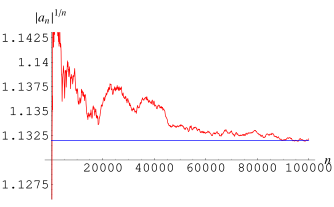
1/2. Viswanath (2000) showed that
(2)
(OEIS A078416 ) with probability one. This constant is sometimes known as Viswanath's
constant.
For a fixed real number real numbers recurrence
relation
(3)
where the signs are again chosen independently with probability
1/2. The limit
(4)
exists with probability one (Embree and Trefethen 1999, p. 2473). Embree and Trefethen (1999, p. 2474) numerically estimated
the critical value
(5)
(OEIS A118288 ). This value is sometimes known
as the Embree-Trefethen constant.
Analogously to the representation of Fibonacci numbers by Fibonacci Q -matrices , these recurrence
relations can be expressed as iterated products of pairs of random matrices (Bougerol
and Lacroix 1985, pp. 11 and 157; Embree and Trefethen 1999, pp. 2477-2478).
The growth rate of the mean of the absolute value , rather than that of an individual sequence ,
is the Rittaud constant .
See also Fibonacci Number ,
Random
Matrix ,
Rittaud Constant
Explore with Wolfram|Alpha
References Batista Oliveira, J. and De Figueiredo, L. H. "Interval Computation of Viswanath's Constant." Reliab. Comput. 8 , 131-138,
2002. https://doi.org/10.1023/A:1014702122205 . Bougerol,
P. and Lacroix, J. Products of Random Matrices with Applications to Schrödinger
Operators. Boston, MA: Birkhäuser, 1985. https://doi.org/10.1007/978-1-4684-9172-2 . Devlin,
K. "Devlin's Angle: New Mathematical Constant Discovered: Descendent of Two
Thirteenth Century Rabbits." Mar. 1999. https://web.archive.org/web/20130515072742/http://www.maa.org/devlin/devlin_3_99.html . Embree,
M. and Trefethen, L. N. "Growth and Decay of Random Fibonacci Sequences."
Roy. Soc. London Proc. Ser. A, Math. Phys. Eng. Sci. 455 , 2471-2485,
1999. https://doi.org/10.1098/rspa.1999.0412 . Livio,
M. The
Golden Ratio: The Story of Phi, the World's Most Astonishing Number. Michon, G. P. "Final
Answers: Numerical Constants." https://www.numericana.com/answer/constants.htm#viswanath . Peterson,
I. "Fibonacci at Random: Uncovering a New Mathematical Constant." Sci.
News 155 , 376, June 12, 1999. https://web.archive.org/web/20130522041809/http://www.sciencenews.org/sn_arc99/6_12_99/bob1.htm . Sloane,
N. J. A. Sequences A078416 and A118288 in "The On-Line Encyclopedia of Integer
Sequences." Viswanath, D. "Random Fibonacci Sequences and the
Number 1.13198824...." Math. Comput. 69 , 1131-1155, 2000. https://doi.org/10.1090/S0025-5718-99-01145-X . Referenced
on Wolfram|Alpha Random Fibonacci Sequence
Cite this as:
Weisstein, Eric W. "Random Fibonacci Sequence."
From MathWorld https://mathworld.wolfram.com/RandomFibonacciSequence.html
Subject classifications



 ,
 ,
 ,
and each sign is chosen independently and at random with probability
1/2. Viswanath (2000) showed that

 and fixed real numbers
 and
 that are not both zero, consider the more general recurrence
relation


 satisfying
 as

 random matrices (Bougerol
and Lacroix 1985, pp. 11 and 157; Embree and Trefethen 1999, pp. 2477-2478).
