Ramanujan continued fractions are generalized continued fractions associated with the work of Ramanujan (Hardy 1999, p. 8).
Examples with closed-form expressions found
by Ramanujan include the almost integers
(OEIS A091667 ; Watson 1929ab; Ramanathan 1984, p. 215; Hardy 1999, p. 8), where golden ratio , its
multiplicative inverse
(OEIS A091899 ; Ramanathan 1984, p. 215),
and
(OEIS A091668 ; Watson 1929ab; Ramanathan 1984, p. 215; Berndt and Rankin 1995, p. 57; Hardy 1999, p. 8) and its multiplicative inverse
(OEIS A091900 ).
Other examples include the integrals
(OEIS A091659 ; Preece 1931, Perron 1954; Berndt and Rankin 1995, pp. 57 and 65; Hardy 1999, p. 8; Berndt and Dixit 2020,
p. 72), where Hurwitz
zeta function and trigamma function ,
and
(OEIS A091660 ; Preece 1931, Perron 1954; Berndt and Rankin 1995, pp. 57 and 65; Berndt and Dixit 2020, p. 72), where polygamma function .
Ramanujan also gave a generalized continued fraction whose convergents have three distinct
subsequential limits . For
(18)
The subsequences with residue classes
modulo 3 converge to distinct points of the Riemann
sphere , although the complete sequence does not
converge (Andrews et al. 2005). Set
(19)
where root of unity and q -Pochhammer
symbollimits are
(20)
for Riemann
sphere . For example, at convergents repeat the
cycle limits for
any integer
See also Continued Fraction Constants ,
Generalized Continued Fraction ,
Rogers-Ramanujan Continued Fraction ,
Stern-Stolz Theorem
Explore with Wolfram|Alpha
References Andrews, G. E.; Berndt, B. C.; Sohn, J.; Yee, A. J.; and Zaharescu, A. "On Ramanujan's Continued Fraction for Trans. Amer. Math. Soc. 355 ,
2397-2411, 2003. https://doi.org/10.1090/S0002-9947-02-03155-0 . Andrews,
G. E.; Berndt, B. C.; Sohn, J.; Yee, A. J.; and Zaharescu, A. "Continued
Fractions with Three Limit Points." Adv. Math. 192 , 231-258, 2005.
https://doi.org/10.1016/j.aim.2004.04.004 . Berndt,
B. C. and Dixit, A. "Ramanujan's Beautiful Integrals." Hardy-Ramanujan
J. 43 , 69-82, 2020. https://doi.org/10.46298/hrj.2021.7429 . Berndt,
B. C. and Rankin, R. A. Ramanujan:
Letters and Commentary. Bowman,
D. and Mc Laughlin, J. "Continued Fractions with Multiple Limits." Adv.
Math. 210 , 578-606, 2007. https://doi.org/10.1016/j.aim.2006.07.004 .
https://arxiv.org/abs/math/0403027 . Hardy,
G. H. Ramanujan:
Twelve Lectures on Subjects Suggested by His Life and Work, 3rd ed. Perron, O. "Über die Preece'schen Kettenbrüche."
Sitz. Bayer. Akad. Wiss. München Math.-Naturwiss. Kl. 1953 , 21-56,
1954. https://publikationen.badw.de/de/003383728/003383728.pdf . Preece,
C. T. "Theorems Stated by Ramanujan (X)." J. London Math. Soc. 6 ,
22-32, 1931. https://doi.org/10.1112/jlms/s1-6.1.22 . Ramanathan,
K. G. "On Ramanujan's Continued Fraction." Acta Arith. 43 ,
209-226, 1984. https://doi.org/10.4064/aa-43-3-209-226 . Ramanujan,
S. The
Lost Notebook and Other Unpublished Papers. Sloane,
N. J. A. Sequences A091659 , A091660 ,
A091667 , A091668 ,
A091899 , and A091900
in "The On-Line Encyclopedia of Integer Sequences." Trott,
M. "Series Expansions." §1.6.4 in The
Mathematica GuideBook for Symbolics. https://doi.org/10.1007/0-387-28815-5 .
https://www.mathematicaguidebooks.org/ . Watson,
G. N. "Theorems Stated by Ramanujan (VII): Theorems on Continued Fractions."
J. London Math. Soc. 4 , 39-48, 1929a. https://doi.org/10.1112/jlms/s1-4.1.39 . Watson,
G. N. "Theorems Stated by Ramanujan (IX): Two Continued Fractions."
J. London Math. Soc. 4 , 231-237, 1929b. https://doi.org/10.1112/jlms/s1-4.3.231 . Referenced
on Wolfram|Alpha Ramanujan Continued Fractions
Cite this as:
Weisstein, Eric W. "Ramanujan Continued Fractions."
From MathWorld https://mathworld.wolfram.com/RamanujanContinuedFractions.html
Subject classifications


 is the golden ratio, its
multiplicative inverse


 is the Hurwitz
zeta function and
 is the trigamma function,
and


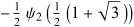


 is a polygamma function.
 , define

 in the three residue classes
modulo 3 converge to distinct points of the Riemann
sphere, although the complete sequence does not
converge (Andrews et al. 2005). Set

 is a cube root of unity and
 is the q-Pochhammer
symbol. The three limits are

 ,
1, 2, with an infinite value interpreted on the Riemann
sphere. For example, at
 the convergents repeat the
cycle
 ,
0, 1, so
 ,
 ,
and
 .
Bowman and Mc Laughlin (2007) give related constructions with
 distinct subsequential limits for
any integer
 .

 ." Trans. Amer. Math. Soc. 355,
2397-2411, 2003.