

The propeller conjecture asserts that three planar sectors of angle  maximize the sum of squared Gaussian first moments over
measurable partitions, after extension in orthogonal
directions. Precisely, if
 is the standard Gaussian
measure on
 , the proposed bound for a set partition
 into measurable
sets is
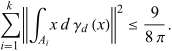 |
The first moments are unnormalized vectors, and the norms are Euclidean. Cell probabilities
are unrestricted, and empty cells are allowed. For  and
 , the three sectors, multiplied
by their orthogonal complement, attain
 , with any remaining cells empty.
Heilman (2026) reported a proof of the bound in every dimension, with equality only for the three-sector construction, up to rotations, relabeling, and changes on sets of measure zero. He also gave a proof for dimension three that does not require computer assistance. The general-dimensional argument still uses numerical checks without rigorous interval error bounds, so the reported resolution requires further verification. Heilman (2026) builds on an AI-generated proof and develops a revised argument.

 ." Disc. Comput. Geom. 50,
263-305, 2013.