

A projection-valued measure on a measurable space  , in the normalized convention, is a function
 from
 to the orthogonal projections on a complex Hilbert space
 with
 ,
 , and countable
additivity in the strong operator topology
(Williams 2018, pp. 15-16). Here
 is the identity operator,
and each
 is a bounded operator satisfying
 , where the star denotes the adjoint
operator. Explicitly, for pairwise disjoint measurable sets
 ,
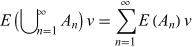 |
for every vector  ,
with convergence in the norm of
 . Convergence in operator
norm is not required. The defining properties imply
 for all
 . In particular, disjoint
sets give orthogonal projections whose
product is zero (Williams 2018, p. 16).
For  , the scalar set
function
 is a complex measure. When
 , it is a positive
measure of total mass
 .
Consequently, a unit vector gives a probability
measure (Williams 2018, p. 16).
The spectral theorem associates to each bounded Hermitian operator  a unique projection-valued measure on the Borel
sets of its operator spectrum
 such that
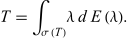 |
This is an operator-valued integral, characterized by  for
all
 (Williams 2018, pp. 17-20).
