


The potato curves problem asks whether two potatoes can each have a simple closed curve drawn on their surfaces so that the two curves coincide when moved into the same position (Hess 1999, p. 56, problem E15). Hess (1999, p. 82) credited the problem to a private communication from Dieter Gebhardt.
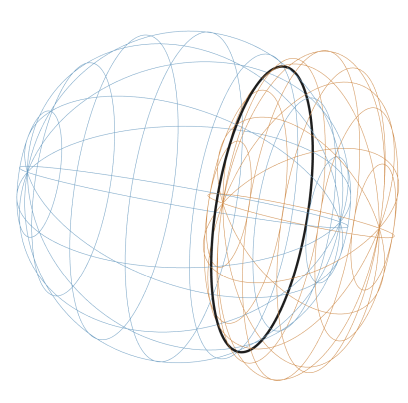
If the potatoes are modeled by nonempty smooth compact embedded surfaces without boundary in three-dimensional Euclidean space, a translation alone suffices. The figure illustrates a sphere and an ellipsoid sharing a circle.
Let  and
 be the two surfaces and define the smooth
map
 |
Choose points  and
 at which the tangent planes are not parallel. Maximize
height on the two surfaces in two nonparallel directions.
At each maximum, the tangent plane is perpendicular
to its chosen direction. At this pair, the tangent map
of
 sends
 to
 and is surjective. The submersion
theorem therefore implies that the image of
 contains a nonempty open set.
By Sard's theorem, that set contains a regular value
 of
 .
Since  is in the image,
 is nonempty. At every point of this intersection,
the tangent planes span
 by regularity of
 . Thus the transversal
intersection is a compact 1-dimensional manifold
without boundary. Each connected component
is a simple closed curve. Any such curve
lies on
 , and translating it by
 gives the matching curve on
 .
