

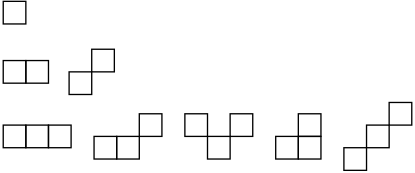
A polyplet is a polyform consisting of a finite nonempty union of cells of the square tessellation, connected through sides or corners. Holes are allowed. Because neighboring squares can be in relation to one another as kings may move on a chessboard, polyplets are sometimes also called polykings. Free polyplets identify translations, rotations, and reflections. One-sided polyplets identify translations and rotations, while fixed polyplets identify only translations.
For  , 2, ..., the numbers of free
 -polyplets are 1, 2, 5, 22, 94, 524, 3031,
... (OEIS A030222). The numbers having bilateral
symmetry are 1, 2, 4, 10, 22, 57, 131, ... (OEIS A030234),
and the numbers not having bilateral symmetry
are 0, 0, 1, 12, 72, 467, 2900, ... (OEIS A030235).
The numbers of fixed
 -polyplets
are 1, 4, 20, 110, 638, 3832, ... (OEIS A006770),
and the numbers of one-sided
 -polyplets
are 1, 2, 6, 34, 166, 991, ... (OEIS A030233).
