A polyomino is a generalization of the domino to a collection of
Polyominoes may be conveniently represented and visualized in the Wolfram
Language using ArrayMesh
Free polyominoes can be picked up and flipped, so mirror image pieces are considered identical. One-sided polyominoes may not be flipped,
but may be rotated, so different rotational orientations are the same, but pieces
having different chiralities are considered distinct. Fixed
polyominoes (also called "lattice animals") are considered distinct if
they have different chirality or orientation.
When the type of polyomino being dealt with is not specified, it is usually assumed that they are free. There is a single unique 2-omino (the domino ),
and two distinct 3-ominoes (the straight- and triominoes ). The 4-ominoes (tetrominoes ) are known as the straight ,
L T square , and skew tetrominoes. The 5-ominoes (pentominoes ) are called et al. 1982).
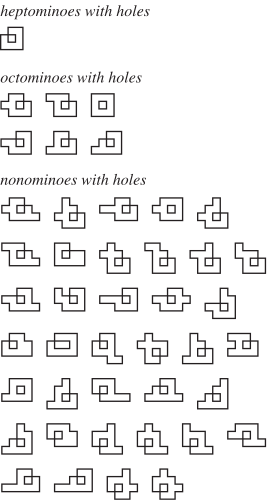
The first few polyominoes with holes are illustrated above (Myers).
Redelmeier (1981) computed the number of free and fixed polyominoes for free (Lunnon 1971, 1972; Read 1978; Redelmeier
1981; Ball and Coxeter 1987; Conway and Guttmann 1995; Goodman and O'Rourke 1997,
p. 229), fixed (Redelmeier 1981), and one-sided polyominoes
(Redelmeier 1981; Golomb 1995; Goodman and O'Rourke 1997, p. 229), as well as
the number containing holes (Parkin et al. 1967, Madachy 1969, Golomb 1994)
for the first few
The best currently known bounds on the number of
(Eden 1961, Klarner 1967, Klarner and Rivest 1973, Ball and Coxeter 1987).
Generalizations of polyominoes to other base shapes other that squares are known as polyforms , with the best-known examples being the
polyiamonds and polyhexes .
See also Column-Convex Polyomino ,
Convex Polyomino ,
Domino ,
Heptomino ,
Hexomino ,
Lattice Polygon ,
Monomino ,
Octomino ,
Pentomino ,
Polyabolo ,
Polycube ,
Polyform ,
Polyhex ,
Polyiamond ,
Polyomino Tiling ,
Polyplet ,
Row-Convex Polyomino ,
Self-Avoiding
Polygon ,
Tetromino ,
Triomino
Explore with Wolfram|Alpha
References Atkin, A. O. L. and Birch, B. J. (Eds.). Computers
in Number Theory: Proc. Sci. Research Council Atlas Symposium No. 2 Held at
Oxford from 18-23 Aug., 1969. Ball,
W. W. R. and Coxeter, H. S. M. Mathematical
Recreations and Essays, 13th ed. Beeler,
M. Item 112 in Beeler, M.; Gosper, R. W.; and Schroeppel, R. HAKMEM.
Cambridge, MA: MIT Artificial Intelligence Laboratory, Memo AIM-239, pp. 48-50,
Feb. 1972. https://www.inwap.com/pdp10/hbaker/hakmem/polyominos.html#item112 . Beineke,
L. W. and Wilson, R. J. (Eds.). Selected
Topics in Graph Theory. Berge,
C.; Chen, C. C.; Chvátal, V.; and Seow, C. S. "Combinatorial
Properties of Polyominoes." Combin. 1 , 217-224, 1981. Berlekamp,
E. R.; Conway, J. H; and Guy, R. K. Winning
Ways for Your Mathematical Plays, Vol. 1: Adding Games, 2nd ed. Berlekamp, E. R.; Conway, J. H; and Guy,
R. K. Winning
Ways for Your Mathematical Plays, Vol. 2: Games in Particular. Bousquet-Mélou, M.; Guttmann, A. J.;
Orrick, W. P.; and Rechnitzer, A. "Inversion Relations, Reciprocity and
Polyominoes." 23 Aug 1999. https://arxiv.org/abs/math/9908123 . Clarke,
A. L. "Polyominoes." http://www.recmath.com/PolyPages/PolyPages/Polyominoes.html . Conway,
A. R. and Guttmann, A. J. "On Two-Dimensional Percolation." J.
Phys. A: Math. Gen. 28 , 891-904, 1995. Eden, M. "A Two-Dimensional
Growth Process." Proc. Fourth Berkeley Symposium Math. Statistics and Probability,
Held at the Statistical Laboratory, University of California, June 30-July 30, 1960.
Berkeley, CA: University of California Press, pp. 223-239, 1961. Finch,
S. R. "Klarner's Polyomino Constant." §5.19 in Mathematical
Constants. Gardner, M. "Mathematical Games: About the Remarkable Similarity
between the Icosian Game and the Towers of Hanoi." Sci. Amer. 196 ,
150-156, May 1957. Gardner, M. "Polyominoes and Fault-Free Rectangles."
Ch. 13 in Martin
Gardner's New Mathematical Diversions from Scientific American. Gardner, M. "Polyominoes
and Rectification." Ch. 13 in Mathematical
Magic Show: More Puzzles, Games, Diversions, Illusions and Other Mathematical Sleight-of-Mind
from Scientific American. Golomb,
S. W. "Checker Boards and Polyominoes." Amer. Math. Monthly 61 ,
675-682, 1954. Golomb, S. W. Polyominoes:
Puzzles, Patterns, Problems, and Packings, 2nd ed. Goodman, J. E. and O'Rourke, J. (Eds.).
Handbook
of Discrete & Computational Geometry. Keller,
M. "Counting Polyforms." https://web.archive.org/web/20030803065351/http://members.aol.com/wgreview/polyenum.html . Klarner,
D. A. "Cell Growth Problems." Can. J. Math. 19 , 851-863,
1967. Klarner, D. A. and Riverst, R. "A Procedure for Improving
the Upper Bound for the Number of Can. J. Math. 25 , 585-602, 1973. Lei,
A. "Bigger Polyominoes." https://web.archive.org/web/20000607193945/http://www.cs.ust.hk/~philipl/omino/bigpolyo.html . Lei,
A. "Polyominoes." https://web.archive.org/web/20000608111230/http://www.cs.ust.hk/~philipl/omino/omino.html . Lunnon,
W. F. "Counting Polyominoes." In Computers
in Number Theory Lunnon, W. F. "Counting
Hexagonal and Triangular Polyominoes." In Graph
Theory and Computing Madachy, J. S. "Pentominoes: Some Solved and Unsolved
Problems." J. Rec. Math. 2 , 181-188, 1969. Martin,
G. Polyominoes:
A Guide to Puzzles and Problems in Tiling. Marzetta, A. "List of Polyominoes of order 4..7." http://wwwjn.inf.ethz.ch/ambros/polyo-list.html . Mertens,
S. "Lattice Animals--A Fast Enumeration Algorithm and New Perimeter Polynomials."
J. Stat. Phys. 58 , 1095-1108, 1990. Montgomery-Smith, S.
"Polyomino Puzzles Software." http://www.math.missouri.edu/~stephen/software/polyomino/ . Myers,
J. "Polyomino Tiling." https://www.polyomino.org.uk/mathematics/polyform-tiling/ . Parkin,
T. R.; Lander, L. J.; and Parkin, D. R. "Polyomino Enumeration
Results." SIAM Fall Meeting. Santa Barbara, CA, 1967. Putter,
G. "Gerard's Universal Polyomino Solver." https://gp.home.xs4all.nl/PolyominoSolver/Polyomino.html . Read,
R. C. "Contributions to the Cell Growth Problem." Canad. J. Math. 14 ,
1-20, 1962. Read, R. C. "Some Applications of Computers in
Graph Theory." In Selected
Topics in Graph Theory Redelmeier, D. H.
"Counting Polyominoes: Yet Another Attack." Disc. Math. 36 ,
191-203, 1981. Ruskey, F. "Information on Polyominoes." https://web.archive.org/web/20130511141730/http://www.theory.csc.uvic.ca/~cos/inf/misc/PolyominoInfo.html . Schroeppel,
R. Item 77 in Beeler, M.; Gosper, R. W.; and Schroeppel, R. HAKMEM. Cambridge,
MA: MIT Artificial Intelligence Laboratory, Memo AIM-239, p. 30, Feb. 1972.
https://www.inwap.com/pdp10/hbaker/hakmem/proposed.html#item77 . Sloane,
N. J. A. Sequences A000105 /M1425,
A000988 /M1749, A001168 /M1639,
and A001419 /M4226 in "The On-Line Encyclopedia
of Integer Sequences." Vichera, M. "Polyforms." https://web.archive.org/web/20250831090700/https://www.vicher.cz/puzzle/polyforms.htm . von
Seggern, D. CRC
Standard Curves and Surfaces. Weisstein, E. W. "Books about Polyominoes." http://www.ericweisstein.com/encyclopedias/books/Polyominoes.html . Wells,
D. Recreations
in Logic. Wells, D. The
Penguin Dictionary of Curious and Interesting Geometry. Referenced on Wolfram|Alpha Polyomino
Cite this as:
Weisstein, Eric W. "Polyomino." From MathWorld https://mathworld.wolfram.com/Polyomino.html
Subject classifications More... Less...


 squares of equal size arranged with coincident
sides. Polyominos were originally called "super-dominoes" by Gardner (1957).
A polyomino with
squares of equal size arranged with coincident
sides. Polyominos were originally called "super-dominoes" by Gardner (1957).
A polyomino with  squares is known as an
  -polyomino
or "
-polyomino
or " -omino."
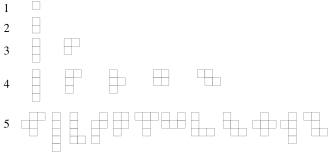
 -triominoes). The 4-ominoes (tetrominoes) are known as the straight,
L, T,
square, and skew tetrominoes. The 5-ominoes (pentominoes) are called
-triominoes). The 4-ominoes (tetrominoes) are known as the straight,
L, T,
square, and skew tetrominoes. The 5-ominoes (pentominoes) are called  ,
,  ,
,
 ,
,  ,
,  ,
,
 ,
,  ,
,  ,
,
 ,
,  ,
,  ,
and
,
and  (Golomb 1995). Another common naming
scheme replaces
(Golomb 1995). Another common naming
scheme replaces  ,
,
 ,
,  , and
, and  with
with  ,
,  ,
,  ,
and
,
and  so that all letters from O to Z are
used (Berlekamp et al. 1982).
so that all letters from O to Z are
used (Berlekamp et al. 1982).
 ,
and Mertens (1990) gives a simple computer program. The following table gives the
number of free (Lunnon 1971, 1972; Read 1978; Redelmeier
1981; Ball and Coxeter 1987; Conway and Guttmann 1995; Goodman and O'Rourke 1997,
p. 229), fixed (Redelmeier 1981), and one-sided polyominoes
(Redelmeier 1981; Golomb 1995; Goodman and O'Rourke 1997, p. 229), as well as
the number containing holes (Parkin et al. 1967, Madachy 1969, Golomb 1994)
for the first few
,
and Mertens (1990) gives a simple computer program. The following table gives the
number of free (Lunnon 1971, 1972; Read 1978; Redelmeier
1981; Ball and Coxeter 1987; Conway and Guttmann 1995; Goodman and O'Rourke 1997,
p. 229), fixed (Redelmeier 1981), and one-sided polyominoes
(Redelmeier 1981; Golomb 1995; Goodman and O'Rourke 1997, p. 229), as well as
the number containing holes (Parkin et al. 1967, Madachy 1969, Golomb 1994)
for the first few  .
.

 -polyominoes are


 -Ominoes." Can. J. Math. 25, 585-602, 1973.Lei,
A. "Bigger Polyominoes."
-Ominoes." Can. J. Math. 25, 585-602, 1973.Lei,
A. "Bigger Polyominoes."