


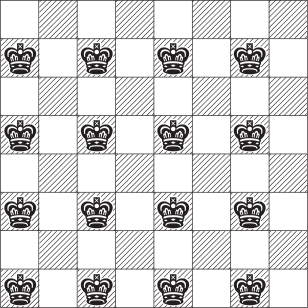
The kings problem asks for the maximum number  of nonattacking kings that can be placed on an
 chessboard, where
 is a positive
integer. For
 , the solution is 16, as illustrated
above (Madachy 1979). In general, the solutions are
 |
(1)
|
(Madachy 1979), giving the sequence of doubled squares 1, 1, 4, 4, 9, 9, 16, 16, ... (OEIS A008794). This sequence has generating function
 |
(2)
|
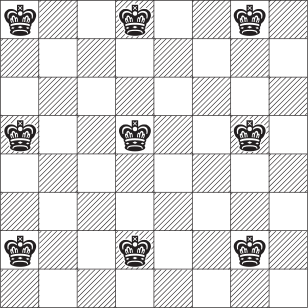
The minimum numbers of kings needed to occupy or attack every square on an  chessboard (i.e., domination numbers for the
 king graphs) are given
for
 , 2, ... by 1, 1, 1, 4, 4, 4, 9, 9, 9, 16, ... (OEIS
A075561), with the
 case illustrated above (Madachy 1979, p. 39). In general, for positive
integers
 and
 , the king graph is the
graph strong product
 of two path graphs, with
 |
(3)
|
where  is the floor function.
