TOPICS
Search

Pentomino


Pentominoes

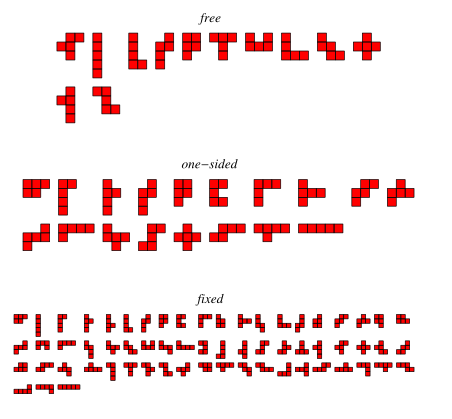
A pentomino is a 5-polyomino. There are 12 free pentominoes, 18 one-sided pentominoes, and 63 fixed pentominoes. The twelve free pentominoes are known by the letters of the alphabet they most closely resemble: f, I, L, N, P, T, U, V, W, X, y, and Z (Gardner 1960, Golomb 1995). Another common naming convention replaces f, I, L, and N with R, O, Q, and S so that all letters from O to Z are used (Berlekamp et al. 1982). In particular, in the game of life cellular automaton, the f-pentomino is always known as the r-pentomino. The I, L, and T pentominoes can also be called the straight pentomino, L-pentomino, and T-pentomino, respectively.

Using all twelve free pentominoes as a polyomino fence gives an enclosure problem, in which the pieces share cell edges and the enclosed free cells may connect at corners.


See also

Domino, Heptomino, Hexomino, Octomino, Polyomino, Tetromino, Triomino

Explore with Wolfram|Alpha

References

Ball, W. W. R. and Coxeter, H. S. M. Mathematical Recreations and Essays, 13th ed. New York: Dover, pp. 110-111, 1987.Berlekamp, E. R.; Conway, J. H; and Guy, R. K. Winning Ways for Your Mathematical Plays, Vol. 2: Games in Particular. London, England: Academic Press, 1982.Berlekamp, E. R.; Conway, J. H; and Guy, R. K. Winning Ways for Your Mathematical Plays, Vol. 1: Adding Games, 2nd ed. Wellesley, MA: A K Peters, 2001.Dudeney, H. E. "The Broken Chessboard." Problem 74 in The Canterbury Puzzles and Other Curious Problems, 7th ed. London, England: Thomas Nelson and Sons, pp. 119-120, 1949.Gardner, M. "Mathematical Games: About the Remarkable Similarity between the Icosian Game and the Towers of Hanoi." Sci. Amer. 196, 150-156, May 1957.Gardner, M. "Mathematical Games: More about the Shapes That Can Be Made with Complex Dominoes." Sci. Amer. 203, 186-198, Nov. 1960.Golomb, S. W. Polyominoes: Puzzles, Patterns, Problems, and Packings, 2nd ed. Princeton, NJ: Princeton University Press, 1995.Hunter, J. A. H. and Madachy, J. S. Mathematical Diversions. New York: Dover, pp. 80-86, 1975.Lei, A. "Pentominoes." https://web.archive.org/web/20000608194656/http://www.cs.ust.hk/~philipl/omino/pento.html.Madachy, J. S. "Pentominoes: Some Solved and Unsolved Problems." J. Rec. Math. 2, 181-188, 1969.Numberphile. "The Pentomino Puzzle (and Tetris)." May 3, 2018. https://www.youtube.com/watch?v=wZ1E_CM7MqA.O'Beirne, T. H. "Pentominoes and Hexiamonds." New Scientist 12, 379-380, 1961. Rangel-Mondragón, J. "Polyominoes and Related Families." Mathematica J. 9, 609-640, 2005. https://content.wolfram.com/sites/19/issue/v9i3.pdf.Ruskey, F. "Information on Pentomino Puzzles." https://web.archive.org/web/20141128111907/http://www.theory.csc.uvic.ca/~cos/inf/misc/PentInfo.html.Smith, A. "Pentomino Relationships." http://www.snaffles.demon.co.uk/pentanomes/.Verbuyst, C. "Pentomino." http://home.planetinternet.be/~odettedm/.

Referenced on Wolfram|Alpha

Pentomino

Cite this as:

Weisstein, Eric W. "Pentomino." From MathWorld--A Wolfram Resource. https://mathworld.wolfram.com/Pentomino.html

Subject classifications