TOPICS
Search

Polynomial Threshold Function


A polynomial threshold function is a Boolean function obtained by thresholding a real polynomial p on {-1,1}^n. The function is f(x)=1 when p(x)>=0 and f(x)=-1 when p(x)<0. It is said to have degree at most d when such a representation exists with a real polynomial of total degree at most d (O'Donnell 2021, p. 115). For n>=2, for example, f(x)=x_1x_2 is represented by p(x)=x_1x_2. Taking p of total degree at most 1 gives linear threshold functions.

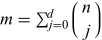
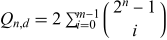
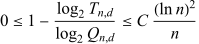
For enumeration, let T_(n,d) count the distinct functions of degree at most d on the Boolean cube, and put m=sum_(j=0)^(d)(n; j). The hyperplane arrangement bound is T_(n,d)<=Q_(n,d), where Q_(n,d)=2sum_(i=0)^(m-1)(2^n-1; i). Anthony (2026) proved

 0<=1-(log_2T_(n,d))/(log_2Q_(n,d))<=C((lnn)^2)/n

for all sufficiently large n, uniformly over 1<=d<=n, with an absolute constant C. This compares logarithms of the counts.


See also

Average Sensitivity, Boolean Function, Linear Threshold Function, Real Polynomial, Total Degree

Explore with Wolfram|Alpha

References

Anthony, M. "Logarithmic Asymptotics for Polynomial Threshold Functions." 25 Oct 2026. https://arxiv.org/abs/2610.34378.O'Donnell, R. Analysis of Boolean Functions. 21 May 2021. https://arxiv.org/abs/2105.10386.

Cite this as:

Weisstein, Eric W. "Polynomial Threshold Function." From MathWorld--A Wolfram Resource. https://mathworld.wolfram.com/PolynomialThresholdFunction.html

Subject classifications