

Polynomial reduction is the successive cancellation of polynomial terms by multiples of specified polynomials, using
a fixed monomial order. Let  be a field and let
 consist of nonzero polynomials
in
 . If a polynomial
term
 of
 has monomial
 divisible by the leading monomial
 of
 , whose leading
coefficient is
 , the reduction step replaces
 by
 |
(1)
|
This cancels  and introduces only smaller monomials.
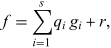
Repeatedly canceling the largest reducible polynomial term terminates because the monomials form a well ordered set. It yields a representation
 |
(2)
|
where no monomial of the remainder  is divisible by a leading
monomial of any
 . The remainder can depend on
the choices of divisors. For example, with
 in
 and lexicographic
order
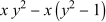
 , the two reductions
 |  |  |
(3)
|
 |  |  |
(4)
|
give distinct remainders, each of which admits no further reduction by  .
If  is a Gröbner basis, the remainder is unique
for the fixed monomial order and depends only on
the ideal generated by
 . In that case,
 belongs to the ideal iff
its remainder is zero. The coefficients
 need not be unique. For an arbitrary generating set,
a zero remainder still implies membership, but a nonzero remainder does not rule
it out. For the preceding
 , the polynomial
 belongs to its ideal and admits no reduction by
 .
Polynomial reduction is implemented in the Wolfram Language as PolynomialReduce[f,
{g1, g2, ...}, {x1, x2, ...}]. It returns the list  together with the remainder
 . For a single divisor in one variable, this specializes
to polynomial division.
