

A polynomial term, in the convention used by Becker and Weispfenning (1993, p. 188), is a product of the form  (in the univariate case), or more generally
 (in the multivariate case), with the coefficient omitted. The exponents
are nonnegative integers.
Another convention includes the coefficient in a term of a polynomial and reserves "monomial"
for the product with its coefficient omitted (Cox
et al. 1997, p. 2). For example,  is a term and
 is a monomial in this convention,
whereas
 is a term in the convention of Becker and Weispfenning. The coefficient-bearing convention
for terms is used in leading term and polynomial
reduction, while leading monomial omits the
coefficient. The word "term" also denotes
a summand of a series (i.e., a series term).
For monomials with the coefficient omitted, one is said to divide another if the powers of its variables are no greater
than the corresponding powers in the second monomial. For example,  divides
 but does not divide
 . A term
 is said to reduce with respect to a polynomial if the leading
monomial of that polynomial divides
 . For example,
 reduces with respect to
 because
 divides
 , and the result of this reduction is
 , or
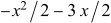 . A polynomial can therefore be reduced by reducing
its terms beginning with the greatest and proceeding downward. Similarly, a polynomial
can be reduced with respect to a set of polynomials by reducing in turn with respect
to each element in that set. A polynomial is fully reduced if none of its terms can
be reduced (Lichtblau 1996).
