TOPICS
Search

Buchberger's Algorithm


Buchberger's algorithm constructs a Gröbner basis from a finite generating set of an ideal in a polynomial ring over a field, for a fixed monomial order. It uses S-polynomial formation and polynomial reduction.

A finite set G of nonzero polynomials is a Gröbner basis iff every S-polynomial of two distinct members reduces to zero by G (Buchberger 2001b, pp. 238-239). Start with the nonzero generators and reduce an S-polynomial by the current set. Adjoin its remainder whenever that remainder is nonzero, and include all new pairs involving the added polynomial. Continue until every pair has been processed.

Adding a remainder preserves the generated ideal. Its leading monomial is not divisible by any previous leading monomial, so each addition strictly enlarges the monomial ideal generated by these leading monomials. The ascending chain condition in the polynomial ring, which is a Noetherian ring, ensures termination. Reducing the final result gives the reduced Gröbner basis.

For example, in Q[x,y] with lexicographic order x>y, the generators f_1=xy-1 and f_2=y^2-1 have S-polynomial

 S(f_1,f_2)=yf_1-xf_2=x-y.

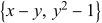
It admits no further reduction by {f_1,f_2}, so it must be added. The resulting reduced Gröbner basis is {x-y,y^2-1}.

See also

Gröbner Basis, Knuth-Bendix Completion Algorithm, Monomial Order, Polynomial Reduction, Reduced Gröbner Basis, S-Polynomial

Explore with Wolfram|Alpha

References

Becker, T. and Weispfenning, V. Gröbner Bases: A Computational Approach to Commutative Algebra. New York: Springer-Verlag, pp. 213-214, 1993.Buchberger, B. "A Theoretical Basis for the Reduction of Polynomials to Canonical Forms." SIGSAM Bull. 10, 19-29, 1976. https://doi.org/10.1145/1088216.1088219.Buchberger, B. "Gröbner Bases: A Short Introduction for Systems Theorists." In Proc. Computer Aided Systems Theory-EUROCAST 2001 (Ed. R. Moreno-Díaz, B. Buchberger, and J. L. Freire). Berlin, Germany: Springer-Verlag, pp. 1-19, 2001a. https://doi.org/10.1007/3-540-45654-6_1.Buchberger, B. "Gröbner Bases and Systems Theory." Multidimensional Systems Signal Process. 12, 223-251, 2001b. https://doi.org/10.1023/A:1011949421611.Cox, D.; Little, J.; and O'Shea, D. Ideals, Varieties, and Algorithms: An Introduction to Computational Algebraic Geometry and Commutative Algebra, 2nd ed. New York: Springer-Verlag, 1997.Giovini, A.; Mora, T.; Niesi, G.; Robbiano, L.; and Traverso, C. "One Sugar Cube, Please?, or Selection Strategies in the Buchberger Algorithm." Proceedings of the International Symposium on Symbolic and Algebraic Computation. pp. 49-54, June 1991.

Referenced on Wolfram|Alpha

Buchberger's Algorithm

Cite this as:

Weisstein, Eric W. "Buchberger's Algorithm." From MathWorld--A Wolfram Resource. https://mathworld.wolfram.com/BuchbergersAlgorithm.html

Subject classifications

