


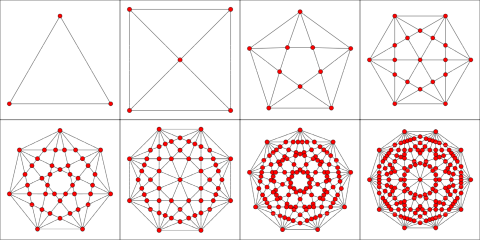
The polygon diagonal intersection graph  is the planar graph obtained
from a regular polygon with
 sides by drawing all its diagonals.
Its vertices are the polygon
vertices and the interior intersection points of the
diagonals. Its edges
are the sides of the regular polygon and the segments
into which the intersection points split the diagonals
(Poonen and Rubinstein 1998).
For purposes of extending the vertex- and edge-count sequences below to  and 2, set
 and
 , where
 is the complete graph.
With these conventions, the vertex counts
 of
 for
 , 2, ... are 1, 2, 3, 5, 10, 19, 42, 57, 135, 171, ... (OEIS
A007569). For
 , these vertex counts
are given by a finite sum of
 |
(1)
|
times polynomials in  with
 , 4, 6, 12, 18, 24, 30, 42, 60, 84, 90, 120, and 210 (Poonen
and Rubinstein 1998).
For  ,
2, ..., the edge counts
 of
 are 0, 1, 3, 8, 20, 42, 91, 136, 288, ... (OEIS A135565),
which are again given by a finite sum of polynomials
times
 .
Similarly, for  , 4, ..., the numbers of regions
 into which the polygon is divided
are given by 1, 4, 11, 24, 50, 80, 154, 220, 375, ... (OEIS A007678),
where the
 th term is given in closed
form by
 |
(2)
|
For odd  , all terms but the first drop out, so the numbers of
regions are given by
 |
(3)
|
Precomputed properties of polygonal diagonal intersection graphs are implemented in the Wolfram Language as GraphData[ "DiagonalIntersection",
n
 ].

 -Gon with Diagonals: Bounds on Area of Largest Cell?"
Dec. 17, 2022.
 ." J. Int. Seq. 13, No. 10.8.5,
2010.