


An unrooted phylogenetic tree on a finite set  of taxa is a tree
whose tree leaves are in bijection
with
of taxa is a tree
whose tree leaves are in bijection
with  ,
with the elements of
,
with the elements of  serving as leaf labels, and which has no vertices
of vertex degree 2. Two such trees
are considered the same when there is a graph isomorphism
between them that fixes every tree leaf label. The leaves usually represent observed taxa; without a root
vertex, the tree records branching relationships but
not an ancestral direction (Semple and Steel 2003).
serving as leaf labels, and which has no vertices
of vertex degree 2. Two such trees
are considered the same when there is a graph isomorphism
between them that fixes every tree leaf label. The leaves usually represent observed taxa; without a root
vertex, the tree records branching relationships but
not an ancestral direction (Semple and Steel 2003).
A rooted phylogenetic tree is defined similarly using a rooted tree, with every internal vertex having at least
two children. A rooted phylogenetic tree is binary when
every internal vertex has exactly two children,
while an unrooted phylogenetic tree is binary when every internal vertex
has vertex degree 3. The root
vertex determines an ancestral direction, and internal vertices
represent hypothetical common ancestors. For  , the number of rooted binary phylogenetic trees is
  for
for  , while the number of unrooted binary phylogenetic trees
is
, while the number of unrooted binary phylogenetic trees
is  for
for  ,
where
,
where  denotes the double factorial (Semple and Steel
2003).
denotes the double factorial (Semple and Steel
2003).
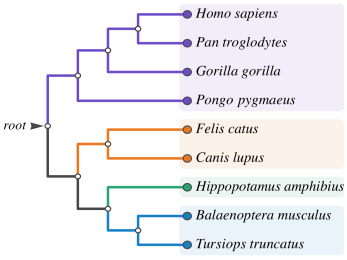
The illustration above shows a stylized rooted binary phylogenetic tree whose leaves are labeled by scientific names. Four colors distinguish groups of related taxa. Horizontal positions show branching order only. The branch lengths are schematic and do not represent evolutionary time.
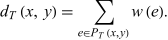
Assigning a nonnegative length  to every edge
  gives an edge-weighted phylogenetic tree. Assuming distinct
leaves have positive distance, the length of the unique
graph path
gives an edge-weighted phylogenetic tree. Assuming distinct
leaves have positive distance, the length of the unique
graph path  between leaves
  and
and  defines
 |
The resulting metric is called a tree metric. Conversely, a finite metric  has an edge-weighted tree representation iff
it satisfies the four-point condition: for
every
has an edge-weighted tree representation iff
it satisfies the four-point condition: for
every  ,
,
 ,
,
 ,
and
,
and  in
in  ,
the maximum of
,
the maximum of  ,
,
 ,
and
,
and  is attained at least twice (Buneman 1971). This characterization connects phylogenetic
reconstruction from pairwise dissimilarities with distance
matrices.
is attained at least twice (Buneman 1971). This characterization connects phylogenetic
reconstruction from pairwise dissimilarities with distance
matrices.

 Alfonsi, J. "Four-Color Graphical Bioinformatics:
The Machinery behind Phylogenetic Trees." Wolfram Community, Aug. 3,
2026.
Alfonsi, J. "Four-Color Graphical Bioinformatics:
The Machinery behind Phylogenetic Trees." Wolfram Community, Aug. 3,
2026.