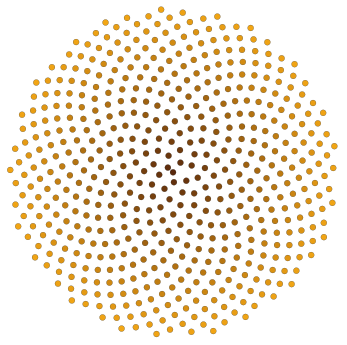
Phyllotaxis is the arrangement of leaves, florets, scales, and other repeated botanical elements around a stem, axis, or center.
The figure above shows a common mathematical model in which florets are placed at
the points of a Vogel spiral
whose divergence angle is the golden
angle.
The beautiful arrangement of leaves in some plants obeys a number of subtle mathematical relationships. For instance, the florets in the head of a sunflower form two oppositely
directed spirals: 55 of them clockwise and 34 counterclockwise.
Surprisingly, these numbers are consecutive Fibonacci
numbers. The ratios of alternate Fibonacci
numbers are given by the convergents to , where is the golden ratio, and
are said to measure the fraction of a turn between successive
leaves on the stalk of a plant: 1/2 for elm and linden, 1/3 for beech and hazel,
2/5 for oak and apple, 3/8 for poplar and rose, 5/13 for willow and almond, etc.
(Coxeter 1969, Ball and Coxeter 1987). A similar phenomenon occurs for daisies,
pineapples, pinecones, cauliflowers, and so on.
Lilies, irises, and the trillium have three petals; columbines, buttercups, larkspur, and wild rose have five petals; delphiniums, bloodroot, and cosmos have eight petals;
corn marigolds have 13 petals; asters have 21 petals; and daisies
have 34, 55, or 89 petals--all Fibonacci numbers.


 , where
  is the golden ratio, and
are said to measure the fraction of a turn between successive
leaves on the stalk of a plant: 1/2 for elm and linden, 1/3 for beech and hazel,
2/5 for oak and apple, 3/8 for poplar and rose, 5/13 for willow and almond, etc.
(Coxeter 1969, Ball and Coxeter 1987). A similar phenomenon occurs for daisies,
pineapples, pinecones, cauliflowers, and so on.
is the golden ratio, and
are said to measure the fraction of a turn between successive
leaves on the stalk of a plant: 1/2 for elm and linden, 1/3 for beech and hazel,
2/5 for oak and apple, 3/8 for poplar and rose, 5/13 for willow and almond, etc.
(Coxeter 1969, Ball and Coxeter 1987). A similar phenomenon occurs for daisies,
pineapples, pinecones, cauliflowers, and so on.

 , and
, and  Flowers: A Spiral Story." Math. Mag. 75,
163-172, 2002.Pappas, T. "The Fibonacci Sequence & Nature."
Flowers: A Spiral Story." Math. Mag. 75,
163-172, 2002.Pappas, T. "The Fibonacci Sequence & Nature."