


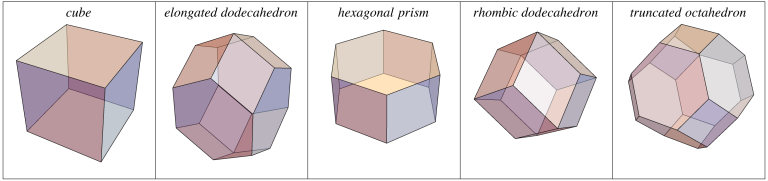
A parallelohedron is a space-filling polyhedron that fills space using an infinite number of similarly situated copies (Tutton 1964, pp. 567 and 723; Coxeter 1973, pp. 29-30). There are exactly five "primary"' parallelohedra: the cube, hexagonal prism, elongated dodecahedron, rhombic dodecahedron, and truncated octahedron (Coxeter 1973, p. 29).
The generalization of the cube to a parallelepiped constructed from three line segments that are not all parallel to a common plane is also a parallelohedron.
Three-dimensional parallelohedra are stereohedra, zonohedra, as well as plesiohedra which are space-filling by translation only.
Hales and Song (2026) and independently Cesaroni and Novaga (2026b) proved the truncated octahedral conjecture. The
Archimedean truncated octahedron uniquely
minimizes surface area among three-dimensional parallelohedra
of fixed volume, up to similarity.
For volume  , the minimum surface
area is
, the minimum surface
area is  .
.
With inradius fixed instead of volume, Cesaroni and Novaga (2026a) proved the rhombic
dodecahedral conjecture. A three-dimensional parallelohedron  of inradius
  has surface area
  , with equality iff
it is similar to a regular rhombic dodecahedron.
Cesaroni and Novaga (2026a) report ChatGPT assistance with algebraic checks and exploration
of proof arguments.
, with equality iff
it is similar to a regular rhombic dodecahedron.
Cesaroni and Novaga (2026a) report ChatGPT assistance with algebraic checks and exploration
of proof arguments.
In higher dimensions, a parallelohedron is a convex polytope whose translates tile Euclidean
space. The regular 24-cell is a four-dimensional
example. Novaga and Song (2026) proved that it uniquely minimizes boundary surface area among four-dimensional parallelohedra of
a prescribed volume, up to similarity.
For volume  , the minimum boundary surface area is
  .
.
