


The integer sequence defined by the recurrence relation
 |
(1)
|
with the initial conditions  . The terms of the Padovan sequence are known as
Padovan numbers. This is the same recurrence relation
as for the Perrin sequence, but with different
initial conditions.
. The terms of the Padovan sequence are known as
Padovan numbers. This is the same recurrence relation
as for the Perrin sequence, but with different
initial conditions.
The recurrence relation can be solved explicitly, giving
 |
(2)
|
where  is the
  th
root of
th
root of
 |
(3)
|
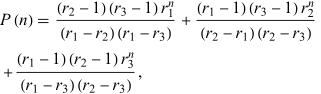
Another form of the solution is
 |
(4)
|
where  is the
  th
root of
th
root of
 |
(5)
|
The first few terms are 1, 1, 2, 2, 3, 4, 5, 7, 9, 12, ... (OEIS A000931).
Using shifted versions of the Padovan sequence and tribonacci sequence, Slavík and Vestenická (2026) count, respectively, tilings
of an  -board
by squares, dominoes, and trominoes,
and tilings by dominoes and trominoes. Denoting these shifted sequences by
-board
by squares, dominoes, and trominoes,
and tilings by dominoes and trominoes. Denoting these shifted sequences by  and
and  , respectively, to distinguish them from the indexing used
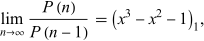
here, they give the convolution identity
, respectively, to distinguish them from the indexing used
here, they give the convolution identity
 |
(6)
|
for  .
.
Padovan sequence numbers that are prime are known as Padovan primes.
The ratio
 |
(7)
|
where  denotes a polynomial root, is called the plastic
constant.
denotes a polynomial root, is called the plastic
constant.
A matrix analogous to the Fibonacci Q-matrix exists for Padovan numbers. Defining
![Q=[0 1 0; 0 0 1; 1 1 0],](/images/equations/PadovanSequence/NumberedEquation8.svg) |
(8)
|
the powers of  give
give
![Q^n=[P_(n-5) P_(n-3) P_(n-4); P_(n-4) P_(n-2) P_(n-3); P_(n-3) P_(n-1) P_(n-2)]](/images/equations/PadovanSequence/NumberedEquation9.svg) |
(9)
|
(J. Lien, pers. comm., Mar. 11, 2005).
