TOPICS
Search

Overdamped Simple Harmonic Motion


SHOOverdamped

Overdamped simple harmonic motion is a special case of damped simple harmonic motion

 x^..+betax^.+omega_0^2x=0,
(1)

with beta>0, omega_0>0, and

 beta^2-4omega_0^2>0.
(2)

Therefore

 D=beta^2-4omega_0^2>0.
(3)
x_1=e^(r_-t)
(4)
x_2=e^(r_+t),
(5)

where

 r_+/-=1/2(-beta+/-sqrt(beta^2-4omega_0^2)).
(6)

The general solution is therefore

 x=Ae^(r_-t)+Be^(r_+t),
(7)

where A and B are constants. The initial conditions are

x(0)=A+B
(8)
x^.(0)=Ar_-+Br_+,
(9)

so

A=x(0)-(r_-x(0)-x^.(0))/(r_--r_+)
(10)
B=(r_-x(0)-x^.(0))/(r_--r_+).
(11)

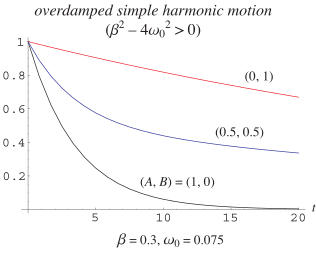
The above plot shows an overdamped simple harmonic oscillator with beta=0.3, omega_0=0.075 and three different initial conditions (A,B).

For a cosinusoidally forced overdamped oscillator with forcing function g(t)=Ccos(omegat) for real omega, i.e.,

 x^..+betax^.+omega_0^2x=Ccos(omegat),
(12)

the associated homogeneous equation has the linearly independent solutions

x_1(t)=e^(r_1t)
(13)
x_2(t)=e^(r_2t),
(14)

where

r_1=1/2(-beta+sqrt(beta^2-4omega_0^2))
(15)
r_2=1/2(-beta-sqrt(beta^2-4omega_0^2)).
(16)

These give the identities

r_1+r_2=-beta
(17)
r_1-r_2=sqrt(beta^2-4omega_0^2)
(18)

and

omega_0^2=1/4[beta^2-(r_1-r_2)^2]
(19)
=r_1r_2.
(20)

We can now use variation of parameters to obtain the particular solution as

 x^*=x_1v_1+x_2v_2,
(21)

where

v_1=-int(x_2(t)g(t))/(W(t))dt
(22)
v_2=int(x_1(t)g(t))/(W(t))dt,
(23)

and the Wronskian is

W(t)=x_1x^._2-x^._1x_2
(24)
=(r_2-r_1)e^((r_1+r_2)t).
(25)

These can be integrated directly to give

v_1=-C/(r_2-r_1)(omegasin(omegat)-r_1cos(omegat))/(e^(r_1t)(r_1^2+omega^2))
(26)
v_2=C/(r_2-r_1)(omegasin(omegat)-r_2cos(omegat))/(e^(r_2t)(r_2^2+omega^2)).
(27)

Substituting and simplifying gives

x^*(t)=C(cos(omegat)(r_1r_2-omega^2)-sin(omegat)omega(r_1+r_2))/((r_1^2+omega^2)(r_2^2+omega^2))
(28)
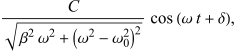
=C/(sqrt(beta^2omega^2+(omega^2-omega_0^2)^2))cos(omegat+delta),
(29)

where use has been made of the harmonic addition theorem and

 delta=arg(omega_0^2-omega^2-ibetaomega).
(30)

Here arg denotes the principal complex argument, which fixes the quadrant of the phase.


See also

Critically Damped Simple Harmonic Motion, Damped Simple Harmonic Motion, Simple Harmonic Motion, Underdamped Simple Harmonic Motion

Explore with Wolfram|Alpha

References

Papoulis, A. Probability, Random Variables, and Stochastic Processes, 2nd ed. New York: McGraw-Hill, pp. 527-528, 1984.

Referenced on Wolfram|Alpha

Overdamped Simple Harmonic Motion

Cite this as:

Weisstein, Eric W. "Overdamped Simple Harmonic Motion." From MathWorld--A Wolfram Resource. https://mathworld.wolfram.com/OverdampedSimpleHarmonicMotion.html

Subject classifications