

A nowhere-zero  -flow
on a graph
-flow
on a graph  consists of a graph orientation
of its edges and an integer
value
consists of a graph orientation
of its edges and an integer
value  assigned to each graph edge such that
 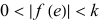 and the sum of the values on edges
directed into each graph vertex equals the sum on
edges directed out of it (Tutte 1954). Existence of
such a flow is independent of the chosen graph orientation.
and the sum of the values on edges
directed into each graph vertex equals the sum on
edges directed out of it (Tutte 1954). Existence of
such a flow is independent of the chosen graph orientation.
For positive integer  , the number of nowhere-zero
  -flows on a graph is given by its
flow polynomial.
-flows on a graph is given by its
flow polynomial.
For a bidirected graph, conservation uses the independent graph orientation at each end of a graph edge. A bidirected graph is flow-admissible if it has a nowhere-zero flow over the integers. Every bidirected graph that is flow-admissible and Eulerian has a nowhere-zero 4-flow. Chen and Fan (2026) strengthen this by showing that the edges on which the flow has magnitude 3 can all be confined to a single circle that is either unbalanced or has at least three edges.
