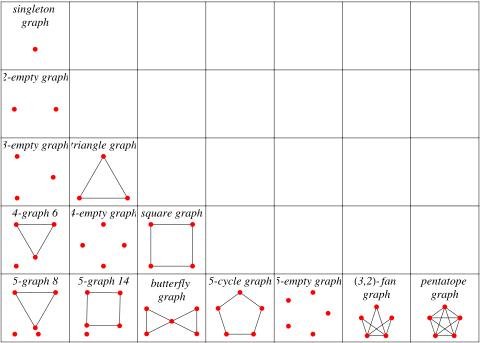
An Eulerian graph is a graph containing an Eulerian cycle. The numbers of Eulerian graphs with , 2, ... vertices are 1,
1, 2, 3, 7, 15, 52, 236, ... (OEIS A133736),
the first few of which are illustrated above.
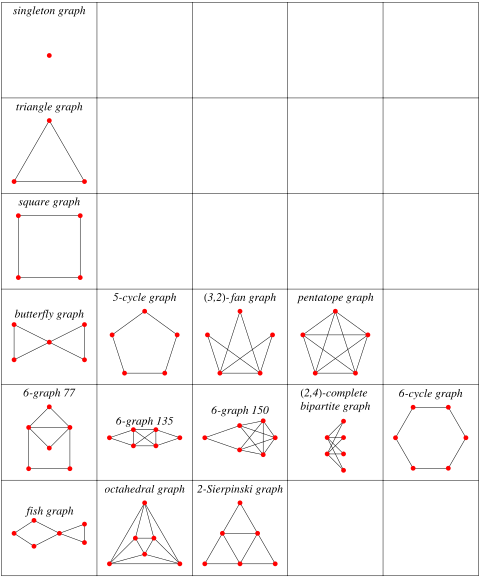
The corresponding numbers of connected Eulerian graphs are 1, 0, 1, 1, 4, 8, 37, 184, 1782, ... (OEIS A003049;
Robinson 1969; Liskovec 1972; Harary and Palmer 1973a, p. 117), the first few
of which are illustrated above.
A graph is Eulerian iff its edge set can be decomposed into cycles
(Veblen 1916, p. 15; Fleischner 1990; Gross and Yellen 2006, p. 195; Heinrich
and Streicher 2019). Determining whether an Eulerian graph can be decomposed into
at most cycles is NP-complete
(Péroche 1984, Heinrich and Streicher 2019). Finding the largest subgraph
of a graph having an odd
number of vertices which is Eulerian is also an NP-complete problem (Skiena 1990, p. 194).
Bollobás, B. Graph Theory: An Introductory Course. New York: Springer-Verlag, p. 12, 1979.Brightwell,
G. R. and Winkler, P. "Note on Counting Eulerian Circuits." CDAM Research
Report LSE-CDAM-2004-12. May 2004. http://www.cdam.lse.ac.uk/Reports/Files/cdam-2004-12.pdf.Colbourn,
C. J. and Dinitz, J. H. (Eds.). CRC
Handbook of Combinatorial Designs. Boca Raton, FL: CRC Press, 1996.Fleischner,
H. Eulerian Graphs and Related Topics. 1990.Frank, A. and Szegő,
L. "Constructive Characterizations for Packing and Covering with Trees."
Discr. Appl. Math.131, 347-371, 2003.Gardner, M. The
Sixth Book of Mathematical Games from Scientific American. Chicago, IL: University
of Chicago Press, p. 94, 1984.Gross, J. T. and Yellen, J.
Graph
Theory and Its Applications, 2nd ed. Boca Raton, FL: CRC Press, 2006.Harary,
F. and Palmer, E. M. "Eulerian Graphs." §1.4 and 4.7 in Graphical
Enumeration. New York: Academic Press, pp. 11-16 and 113-117, 1973a.Harary,
F. and Palmer, E. M. "A Survey of Graphical Enumeration Problems."
In A Survey of Combinatorial Theory (Ed. J. N. Srivastava). Amsterdam,
Netherlands: North-Holland, pp. 259-275, 1973b.Heinrich, I. and
Streicher, M. "Cycle Decompositions and Constructive Characterizations."
7 Jan 2019. https://arxiv.org/abs/1708.09141.Liskovec,
V. A. "Enumeration of Euler Graphs" [Russian]. Review MR#6557 in Math.
Rev.44, 1195, 1972.McKay, B. "Eulerian Graphs."
https://users.cecs.anu.edu.au/~bdm/data/graphs.html.Péroche,
B. "NP-Completeness of Some Problems of Partitioning and Covering in Graphs."
Discr. Appl. Math.8, 195-208, 1984.Skiena, S. "Eulerian
Cycles." §5.3.3 in Implementing
Discrete Mathematics: Combinatorics and Graph Theory with Mathematica. Reading,
MA: Addison-Wesley, pp. 192-196, 1990.Sloane, N. J. A.
Sequences A003049/M3344 and A133736
in "The On-Line Encyclopedia of Integer Sequences."Veblen,
O. Analysis Situs. New York: Amer. Math. Soc., 1916.


 , 2, ... vertices are 1,
1, 2, 3, 7, 15, 52, 236, ... (OEIS A133736),
the first few of which are illustrated above.
, 2, ... vertices are 1,
1, 2, 3, 7, 15, 52, 236, ... (OEIS A133736),
the first few of which are illustrated above.
 vertices
is equal to the number of connected Eulerian graphs
on
vertices
is equal to the number of connected Eulerian graphs
on  vertices,
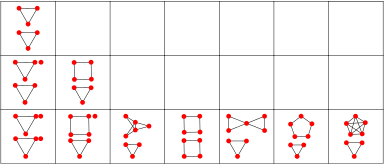
the counts are different for disconnected graphs
since there exist disconnected graphs having
multiple disjoint cycles with each graph
vertex of even vertex
degree but for which no single Eulerian cycle
passes through all edges.
vertices,
the counts are different for disconnected graphs
since there exist disconnected graphs having
multiple disjoint cycles with each graph
vertex of even vertex
degree but for which no single Eulerian cycle
passes through all edges.
 cycles is NP-complete
(Péroche 1984, Heinrich and Streicher 2019). Finding the largest subgraph
of a graph having an odd
number of vertices which is Eulerian is also an NP-complete problem (Skiena 1990, p. 194).
cycles is NP-complete
(Péroche 1984, Heinrich and Streicher 2019). Finding the largest subgraph
of a graph having an odd
number of vertices which is Eulerian is also an NP-complete problem (Skiena 1990, p. 194).


