

A bidirected graph is a signed graph in which the two ends of every graph edge are oriented independently. Equivalently, each half-edge  incident with a graph vertex
  is assigned a value
  indicating an orientation away from or toward
 . The two ends of a positive graph
edge have opposite orientations, while the ends of a negative graph
edge have the same orientation.
. The two ends of a positive graph
edge have opposite orientations, while the ends of a negative graph
edge have the same orientation.
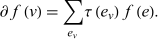
For a function  with values in an Abelian
group
with values in an Abelian
group  ,
its boundary at
,
its boundary at  is
is
 |
The function is an  -flow if
  at every graph vertex.
A bidirected graph is flow-admissible if it has a nowhere-zero
flow over the integers. Every flow-admissible bidirected
Eulerian graph has a nowhere-zero
flow with values of magnitude less than 4 (Máčajová and Škoviera
2017), and Chen and Fan (2026) refine this by confining every graph
edge of flow magnitude 3 to one suitable circle.
at every graph vertex.
A bidirected graph is flow-admissible if it has a nowhere-zero
flow over the integers. Every flow-admissible bidirected
Eulerian graph has a nowhere-zero
flow with values of magnitude less than 4 (Máčajová and Škoviera
2017), and Chen and Fan (2026) refine this by confining every graph
edge of flow magnitude 3 to one suitable circle.
