

A noncrossing partition is a set partition of a cyclically ordered finite set such that no two distinct
set blocks interlace. For labels 1, 2, ...,  in cyclic order, this means there are no
 with
 and
 in one set block and
 and
 in another. Equivalently, placing the labels on a circle
makes the convex hulls of distinct set
blocks disjoint (Simion 2000). Labels are fixed;
rotations and reflections are not identified.
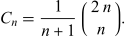
The number of noncrossing partitions of  labels is the Catalan number
 |
(1)
|
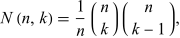
The number with exactly  set blocks is the Narayana
number
 |
(2)
|
for  (Simion 2000). Excluding singleton set blocks gives
the Riordan numbers.
If every set block has at least three elements, its convex hull is a polygon.
These disjoint polygons
partition the vertices, rather than dissecting the entire polygonal area. The number
with  set blocks is
 |
(3)
|
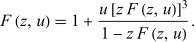
for  (OEIS A350248). With
 , the generating
function
 satisfies
 |
(4)
|
The set block containing the first label separates the remaining labels into gaps, each carrying an independent noncrossing partition of
the same kind. This gives the functional equation;
Lagrange inversion theorem then gives
 . The total counts for
 , 1, 2, ... are 1, 0, 0, 1, 1, 1, 4, 8, 13, 31, ...
(OEIS A114997). In particular, a labeled hexagon has three partitions into two triangles,
in addition to its single-block partition.
