

An inverse-square law is a dependence  on the distance
 from a source, where
 is independent of
 . For a radial vector field
in three-dimensional Euclidean space, suppose
its radial component has spherical symmetry
and its outward flux integral
 is constant through concentric spheres. Since a sphere of radius
 has surface area
 , the spherical symmetry
gives
 |
where  is the outward radial unit vector (Staelin 2011, p. 18).
The divergence of this vector field is zero away from the source. For nonzero  , the flux
integral through an enclosing sphere is consistent
with the divergence theorem because the vector field has a singularity
at the source. Thus the theorem cannot be applied there without accounting for the
singularity.
More generally, in  -dimensional
Euclidean space with
 , the corresponding radial law is
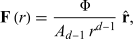 |
where  is the hyper-surface area of the unit hypersphere,
and
 is the gamma function. When
 , the inverse-square case is therefore specific to three
dimensions. The gravitational inverse-square law is the hypothesis underlying Newton's shell theorem.
