TOPICS
Search

Net Change Theorem


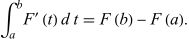
The net change theorem states that the definite integral of a rate of change gives the signed change of the underlying quantity. If F(t) is continuous on [a,b] and its derivative on (a,b) extends continuously to [a,b], then

 int_a^bF^'(t)dt=F(b)-F(a).

This is the second fundamental theorem of calculus with the integrand interpreted as a rate (Strang and Herman 2016).

For motion on a line, integrating velocity gives displacement. Integrating speed, the absolute value of velocity, gives total distance traveled. For instance, a particle with velocity v(t)=2t-2 for 0<=t<=2 has zero displacement but travels a total distance of 2.


See also

Definite Integral, Second Fundamental Theorem of Calculus

Explore with Wolfram|Alpha

References

Strang, G. and Herman, E. J. "Integration Formulas and the Net Change Theorem." §5.4 in Calculus, Vol. 1. Houston, TX: OpenStax, 2016. https://openstax.org/books/calculus-volume-1/pages/5-4-integration-formulas-and-the-net-change-theorem.

Cite this as:

Weisstein, Eric W. "Net Change Theorem." From MathWorld--A Wolfram Resource. https://mathworld.wolfram.com/NetChangeTheorem.html

Subject classifications