


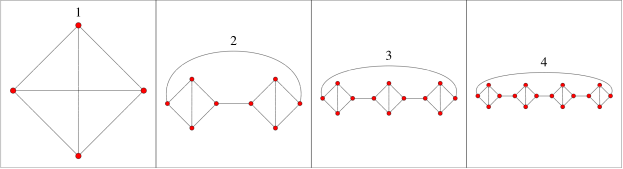
An  -necklace graph is a cubic
graph on
-necklace graph is a cubic
graph on  vertices obtained from a cycle
graph
vertices obtained from a cycle
graph  by adding an additional vertex associated with every
third vertex
by adding an additional vertex associated with every
third vertex  of the cycle graph and connecting
each new vertex with vertices
of the cycle graph and connecting
each new vertex with vertices  ,
,  , and
, and  of the cycle graph (DeAlba
et al. 2009, American Institute of Mathematics). In other words, it is the
graph obtained by connecting
of the cycle graph (DeAlba
et al. 2009, American Institute of Mathematics). In other words, it is the
graph obtained by connecting  diamond graphs placed around
a circle with a total of
diamond graphs placed around
a circle with a total of  edges, where edges
are used to connect vertices of vertex
degree 2 in neighboring diamond graphs. The
graph might therefore even more appropriately be termed
the "diamond necklace graph." The first few necklace graphs for
edges, where edges
are used to connect vertices of vertex
degree 2 in neighboring diamond graphs. The
graph might therefore even more appropriately be termed
the "diamond necklace graph." The first few necklace graphs for  , 2, ... are illustrated above. The (degenerate)
  case gives the tetrahedral
graph
case gives the tetrahedral
graph  .
.
With the exception of  ,
,
 -necklace graphs are unit-distance
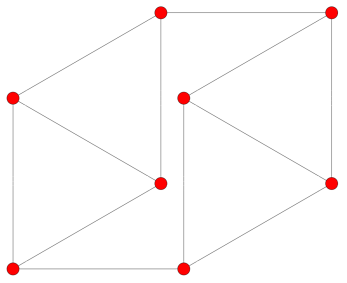
and matchstick graphs. In fact, the 2-necklace
graph is the minimum 3-regular matchstick
graph, illustrated above in a matchstick graph drawing.
-necklace graphs are unit-distance
and matchstick graphs. In fact, the 2-necklace
graph is the minimum 3-regular matchstick
graph, illustrated above in a matchstick graph drawing.
Amazingly and amusingly, the  -necklace graph has exactly
  independent edge sets
(E. Weisstein Feb. 10, 2026).
independent edge sets
(E. Weisstein Feb. 10, 2026).
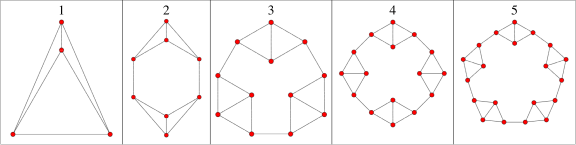
The  -necklace
graph is the
-necklace
graph is the  special case of a graph based on the truncated square lattice,
known in this work as the truncated square
lattice graph.
special case of a graph based on the truncated square lattice,
known in this work as the truncated square
lattice graph.
