

Moser's cube problem asks for the largest size  of a subset of
 containing no three distinct collinear points in real Euclidean space
(Moser 1970). The exact values begin 2, 6, 16, 43, 124, 353, ... (OEIS A003142),
with the displayed terms corresponding to
 , 2, ..., 6 (Polymath 2010). General values remain unknown.
The density Hales-Jewett theorem implies 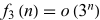 ,
since a combinatorial line is a collinear
triple. Here
 denotes little-O notation. This real-geometric
condition differs from the cap set condition over the
finite field with three elements. For example, a
full line parallel to a coordinate axis is forbidden in both settings, but in dimension
2 the respective maxima are 6 and 4 (Polymath 2010).
The density-zero assertion is problem 185 in the Erdős problems collection (Bloom 2026).
