

The moment problem asks whether a given sequence can be represented as the moments of a positive
measure and whether that measure is unique. The support
of the measure is part of the problem. For a prescribed
subset  of the real line, the required
representation is
 |
for  ,
1, .... Such a sequence is a moment
sequence.
Hausdorff's moment problem, also called the little moment problem, takes  . It asks for a nondecreasing function
 of bounded
variation on this interval such that
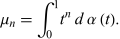 |
Hausdorff (1921ab) obtained necessary and sufficient conditions for this representation.
A positive measure on a bounded closed interval is uniquely determined by all its moments. This need not hold on the entire real line. Favard's theorem gives a positive measure for a three-term recurrence relation of orthogonal polynomials, but does not in general make that measure unique.
