


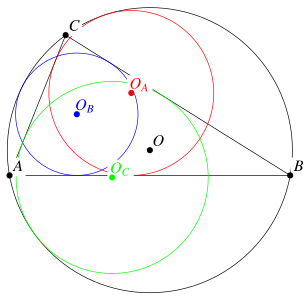
A mixtilinear incircle is a circle that is internally tangent to the circumcircle of a triangle and tangent to two of its sides. There are three mixtilinear incircles, one corresponding to each angle of the triangle.
The radius of the  -mixtilinear incircle inscribed in
 is given by
 |
(1)
|
where  is the inradius of the reference
triangle (Durell and Robson 1935), and the triangle
center function is
 |
(2)
|
These can be derived by considering exact trilinear coordinates  and noting the condition that the
 -circle be tangent
to sides
 and
 means that
 |
(3)
|
Let  be the distance between the centers of the
 -circle and circumcircle,
as found using the distance formula in trilinear
coordinates. Since these two circles are internally
tangent,
 |
(4)
|
Combining this with the condition for exact trilinear coordinates  then gives two equations
that can be solved for the unknowns
 and
 .
The points of tangency of the  -mixtilinear incircle with sides
 and
 are found by intersecting these sides
with the line through the incenter
 perpendicular
to the angle bisector
 (Veldkamp 1976-1977).
The radical line of the two mixtilinear incircles tangent to side  passes through the midpoint
of the arc
 not containing
 and through the midpoint of the
radius of the incircle perpendicular to
 (Nguyen and Salazar 2006).
Let  be the point of tangency of the mixtilinear incircle inscribed in
 and the circumcircle.
Similarly define
 and
 .
Then the lines
 ,
 , and
 are concurrent. The point
of concurrency is the external similitude
center of the circumcircle and incircle,
which is Kimberling center
 (Yiu 1999).
The triangle joining the centers is the mixtilinear triangle and its circumcircle is the mixtilinear circle.
The two intersections of each mixtilinear incircle with the opposite side of its reference
triangle give six points on a common conic
section (E. A. José García, pers. comm., Oct. 27,
2013). To verify this, write  ,
 ,
 , and let
 be the semiperimeter.
The distance from
 to either point of tangency on
 or
 is
 . If
 and
 are the intersections of
the
 -mixtilinear
incircle with
 ,
then circle power gives
 |  |  |
(5)
|
 |  |  |
(6)
|
Multiplying the ratio of these expressions and the two cyclically corresponding ratios gives 1, so the conclusion follows from Carnot's conic theorem (Bogomolny).
