


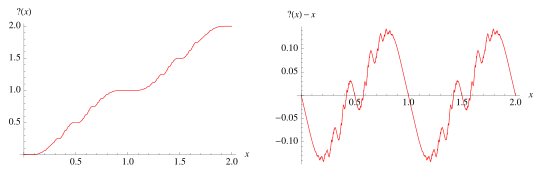
Minkowski's question mark function is the strictly increasing function  on
 defined by
 and
 |
(1)
|
for  with continued fraction
 , with the sum
terminating for rational
 . It maps quadratic surds
in the open interval
 to rational numbers
in that interval in a continuous, order-preserving
manner. For the nonnegative arguments outside
 used below, the extension is
 for a nonnegative integer
 and
 .
It is implemented in the Wolfram Language as MinkowskiQuestionMark[x].
On  ,
the function satisfies the following properties (Salem
1943).
1.  is a strictly increasing function.
2. If  is rational, then
 is of the form
 , with
 and
 integers.
3. If  is a quadratic surd, then its continued
fraction is eventually periodic,
and hence
 is rational.
4. The function is purely singular (Denjoy 1938).
The function  can also be constructed as
 |
(2)
|
where  and
 are two consecutive irreducible fractions from
a Farey sequence. Starting with
 and
 , insert the mediant between
each adjacent pair at every stage. After
 stages,
 is defined at
 arguments, and the corresponding ordinates are
 for
 , 1, ...,
 (Salem 1943).
For positive integers  and
 , the function satisfies the identity
 |
(3)
|
A few special values include
 |  |  |
(4)
|
 |  |  |
(5)
|
 |  |  |
(6)
|
 |  |  |
(7)
|
 |  |  |
(8)
|
 |  |  |
(9)
|
 |  |  |
(10)
|
 |  |  |
(11)
|
where  is the golden ratio.
The function satisfies the symmetry
 |
(12)
|
where  .
Its only rational fixed
points on
 are 0, 1/2, and 1. There are also irrational fixed points
 and
 , where
 (OEIS A048819)
is the Minkowski-Bower constant, the
smallest positive fixed point.
It is conjectured that these five fixed points are
the only ones on
 , or four modulo 1 (Gayfulin and Shulga 2020).
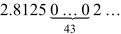
Values  with large terms in their continued fractions
cause
 to have a large section of repeating 0's or 9's (E. Pegg, Jr., pers. comm.,
Jan. 5, 2023). Some examples include
 |  |  |
(13)
|
 |  |  |
(14)
|
 |  |  |
(15)
|

 Function." J. Number Th. 73, 212-227,
1998.Yakubovich, S. "The Affirmative Solution to Salem's Problem
Revisited." 31 Dec 2014.