

The minimal residual method (MINRES) is a variant of the conjugate gradient method for symmetric indefinite systems. The symmetric LQ method (SYMMLQ) is another such variant.
The vector sequences in the conjugate gradient method correspond to a factorization of a tridiagonal matrix similar to the coefficient matrix. Therefore, a breakdown of the algorithm can occur corresponding to a zero pivot if the matrix is indefinite. Furthermore, for indefinite matrices the minimization property of the conjugate gradient method is no longer well-defined. The MINRES methods is a variant of the conjugate gradient method that avoids the LU decomposition and does not suffer from breakdown. MINRES minimizes the residual in the 2-norm. The convergence behavior of the conjugate gradient and MINRES methods for indefinite systems was analyzed by Paige et al. (1995).
When  is not positive definite, but symmetric, we can still construct an orthogonal basis
for the Krylov subspace by three-term recurrence relations. Eliminating the search
directions in the equations of the conjugate
gradient method gives a recurrence
is not positive definite, but symmetric, we can still construct an orthogonal basis
for the Krylov subspace by three-term recurrence relations. Eliminating the search
directions in the equations of the conjugate
gradient method gives a recurrence
 |
(1)
|
which can be written in matrix form as
 |
(2)
|
where  is an
is an  tridiagonal matrix.
In this case we have the problem that  no longer defines an inner product. However
we can still try to minimize the residual in the 2-norm by obtaining
no longer defines an inner product. However
we can still try to minimize the residual in the 2-norm by obtaining
 |
(3)
|
with
 |
(4)
|
chosen to minimize
 |  |  |
(5)
|
 |  | 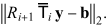 |
(6)
|
Now we exploit the fact that if
 |
(7)
|
then  is an orthonormal transformation with respect to the current Krylov subspace
 |
(8)
|
and this final expression can simply be seen as a minimum norm least squares problem.
The element in the  position of
  can be annihilated by a simple Givens rotation and the
resulting upper bidiagonal system (the other subdiagonal elements having been removed
in previous iteration steps) can simply be solved, which leads to the MINRES method
(Paige and Saunders 1975).
can be annihilated by a simple Givens rotation and the
resulting upper bidiagonal system (the other subdiagonal elements having been removed
in previous iteration steps) can simply be solved, which leads to the MINRES method
(Paige and Saunders 1975).
