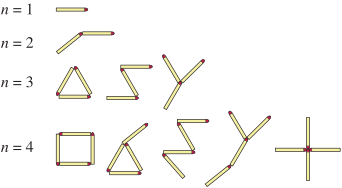
The match problem asks for the number of topologically distinct connectedplanar arrangements made from matches (rigid unit line segments)
(Gardner 1991). In this problem, two matches laid end-to-end with no third match
at their meeting point are considered equivalent to a single match, so triangles
are equivalent to squares, -match tails are equivalent to 1-match tails, etc.
Gardner, M. "The Problem of the Six Matches." In The
Unexpected Hanging and Other Mathematical Diversions. Chicago, IL: Chicago
University Press, pp. 79-81, 1991.Read, R. C. "From Forests
to Matches." J. Recr. Math.1, 60-172, Jul. 1968.Sloane,
N. J. A. Sequence A003055/M2464
in "The On-Line Encyclopedia of Integer Sequences."


 matches (rigid unit line segments)
(Gardner 1991). In this problem, two matches laid end-to-end with no third match
at their meeting point are considered equivalent to a single match, so triangles
are equivalent to squares,
 -match tails are equivalent to 1-match tails, etc.
 counts the original matches, rather than the edges
remaining after graph smoothing. The first counts
for
 , 2, ... are 1, 1, 3, 5, 10, 19, 39,
84, 196, 479, ... (OEIS A003055).
