


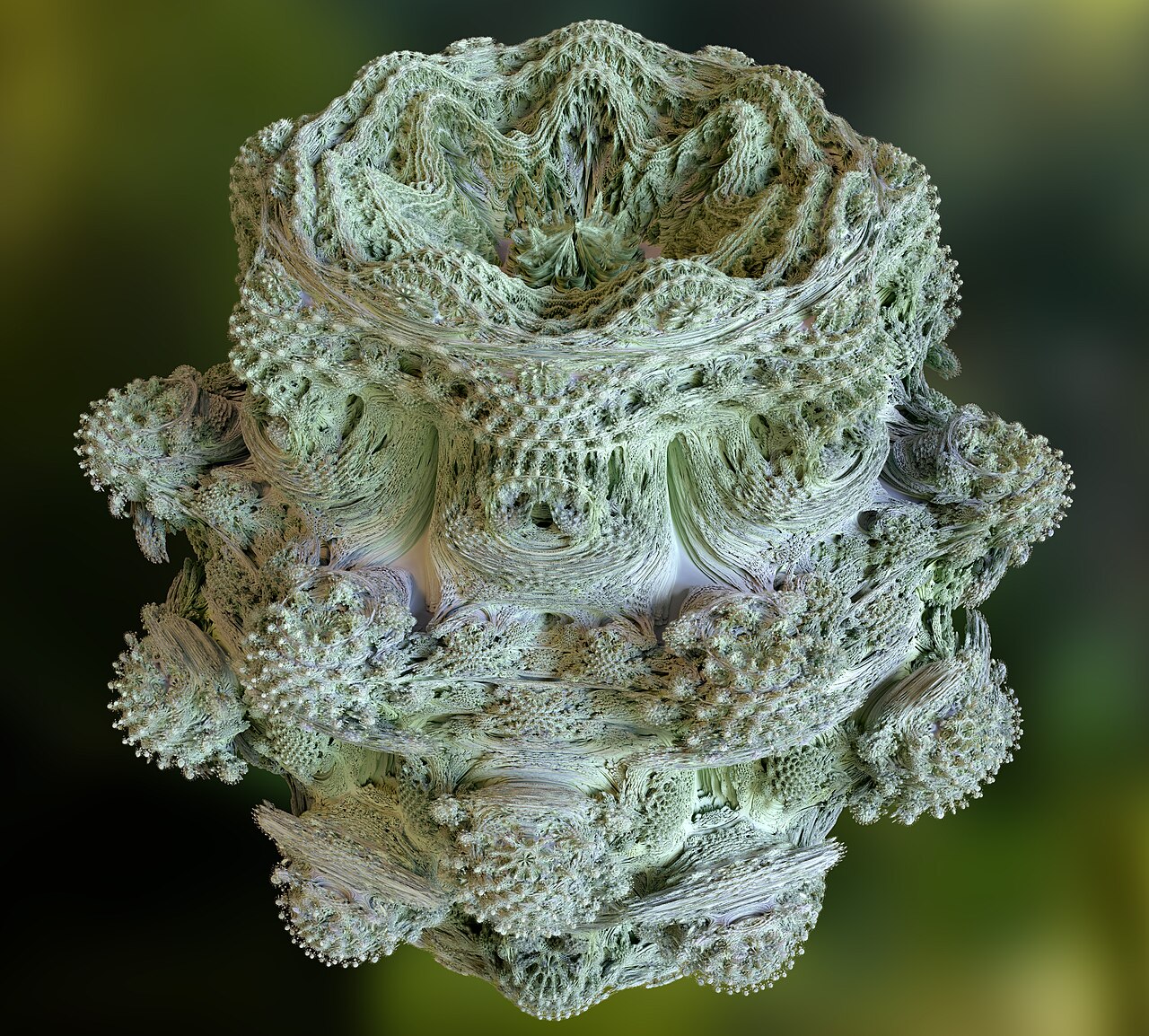
The Mandelbulb is a three-dimensional fractal defined by an analog in spherical coordinates of
the power operation used for the Mandelbrot
set. For the nonzero vector  , write
 |  |  |
(1)
|
 |  |  |
(2)
|
 |  |  |
(3)
|
where  denotes the complex argument of the complex
number
denotes the complex argument of the complex
number  and
and  is taken when
  . For a positive integer
  , White and Nylander's spherical power
is
, White and Nylander's spherical power
is
 |
(4)
|
Set  . The degree-
 Mandelbulb is the set of vectors
  for which the orbit
of
for which the orbit
of  under
under
 |
(5)
|
is bounded. The best-known images use  , an example of which is illustrated above (Wikimedia).
Knill (2023) calls the degree-2 White-Nylander Mandelbulb the "Mandelbug," whose  cross section is the Mandelbrot
set.
cross section is the Mandelbrot
set.
The spherical construction is not unique. Replacing the angular factors  and
and  by
by  and
and  , while retaining the radial factor
  , gives a related family with independent parameters
  and
and  . For odd
  , the trigonometric components can be rewritten as rational
functions of
, the trigonometric components can be rewritten as rational
functions of  ,
,
 , and
, and  , with values on the
  -axis supplied by the original definition.
For
-axis supplied by the original definition.
For  , numerical renderings show a bulb-like
form with repeated surface lobes whose number and arrangement depend on
, numerical renderings show a bulb-like
form with repeated surface lobes whose number and arrangement depend on  (White 2009).
Unlike complex multiplication, the displayed spherical power is a chosen three-dimensional construction
rather than the multiplication law of a three-dimensional number
field. In particular, the notation does not in general satisfy 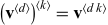 . The Mandelbulb is
therefore an analog of the Mandelbrot set, not
a canonical three-dimensional extension of it. Analogs of the Mandelbrot
set based on quaternions and bicomplex
numbers instead naturally occupy four real dimensions.
Whether Mandelbulbs are connected remains an open
question (Knill 2023). The related Hopfbrot applies
an analogous construction in
. The Mandelbulb is
therefore an analog of the Mandelbrot set, not
a canonical three-dimensional extension of it. Analogs of the Mandelbrot
set based on quaternions and bicomplex
numbers instead naturally occupy four real dimensions.
Whether Mandelbulbs are connected remains an open
question (Knill 2023). The related Hopfbrot applies
an analogous construction in  using Hopf coordinates on the 3-sphere.
In these coordinates, a common angular coordinate runs along the circular fibers
of the Hopf map from the 3-sphere
to the 2-sphere.
using Hopf coordinates on the 3-sphere.
In these coordinates, a common angular coordinate runs along the circular fibers
of the Hopf map from the 3-sphere
to the 2-sphere.
Images of a Mandelbulb approximate membership by stopping each orbit after a finite number of iterations or when it escapes. High-quality surface renderings commonly advance along each viewing ray using a local distance estimate to locate the boundary efficiently (da Silva et al. 2021).
White proposed the construction in spherical coordinates in 2007, and Nylander's experiments with higher powers in 2009 led to the detailed degree-8 images that popularized the Mandelbulb (Rucker 2009, White 2009). Nylander documented his experiments on his Hypercomplex Fractals page. Mandelbulb variants have also been used in film. In Big Hero 6, the portal environment was generated by a variation of the Mandelbulb algorithm and rendered as volumetric data (Hutchins et al. 2015). Modified Mandelbulb forms supplied the basis for the Shimmer and the alien visualization in Annihilation (Frei 2018).

