A magic graph in the sense of Sedláček and Doob is a graph whose graph edges can be given distinct nonnegative
labels so that the sum of the labels on the graph edges
incident to each graph vertex is the same. When the
labels are 1, 2, ..., ,
this is called a vertex-magic edge labeling, since it is the weights of the graph
vertices that are constant.
A different recreational use of "magic graph" labels graph vertices so that every straight line segment has the same sum. No magic pentagrams
can be formed with the numbers 1, 2, ..., 10 (Trigg 1960; Langman 1962, pp. 80-83;
Dongre 1971; Richards 1975; Buckley and Rubin 1977-1978; Trigg 1998), but 168 almost
magic pentagrams (in which the sums are the same for four of the five lines) can.
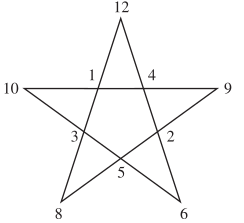
The figure above shows a magic pentagram with sums 24 built using the labels 1, 2,
3, 4, 5, 6, 8, 9, 10, and 12 (Madachy 1979).


 ,
this is called a vertex-magic edge labeling, since it is the weights of the graph
vertices that are constant.
,
this is called a vertex-magic edge labeling, since it is the weights of the graph
vertices that are constant.
 ,
and the weight
,
and the weight  is constant over all graph edges
  (Gallian 2025).