


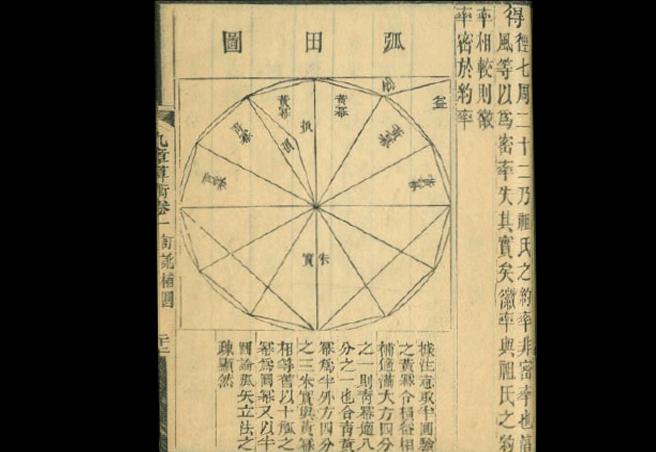
Liu Hui's exhaustion method is an algorithm for approximating pi by successively doubling the number of sides of an inscribed regular polygon. Liu described the method in his 263 commentary on The Nine Chapters on the Mathematical Art (Martzloff 1997, Dauben 2007). Starting from a regular hexagon, he continued through a 192-gon and obtained the bounds
 |
(1)
|
from which he recommended the pi approximation  (Martzloff 1997, Dauben 2007).
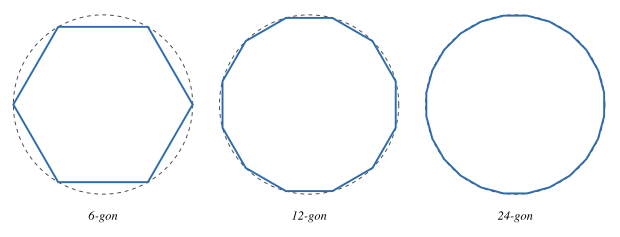
For a circle of radius  ,
let
,
let  be the side length of the inscribed regular
polygon and let
be the side length of the inscribed regular
polygon and let  be its apothem. Then
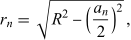 |
(2)
|
and bisecting a central angle gives the doubling recurrence
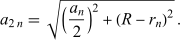 |
(3)
|
The area of the regular  -gon is
 |
(4)
|
Beginning with  and repeatedly applying these formulas produces a monotonic sequence of lower bounds
on the area
and repeatedly applying these formulas produces a monotonic sequence of lower bounds
on the area  of the circle.
