

The law of the iterated logarithm gives the almost-sure asymptotic magnitude of the fluctuations of a sum of independent random variables.
If  ,
,
 ,
... are independent and identically
distributed with expectation value 0 and
finite positive variance
,
... are independent and identically
distributed with expectation value 0 and
finite positive variance  , and
, and  , then
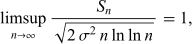 |
almost surely. Applying the result to  gives the corresponding infimum
limit
gives the corresponding infimum
limit  .
.
The theorem refines the law of large numbers: the latter gives the scale on which  tends to 0, while the iterated logarithm gives the precise
envelope of the remaining fluctuations.
tends to 0, while the iterated logarithm gives the precise
envelope of the remaining fluctuations.
