

Kepler's wine barrel problem is the problem of finding the right circular cylinder of greatest volume for a fixed gauging length measured diagonally from a bung at the midpoint of its side to the opposite rim of an end.
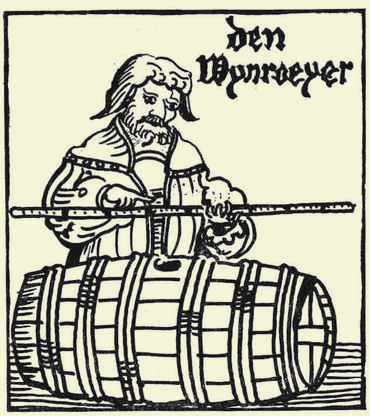
The problem arose after Johannes Kepler bought wine for his household and observed the merchant's diagonal-rod method in 1613 (Caspar 1993, pp. 233-240; Cardil 2012). Kepler developed the question into a study of the volumes of nearly 100 solids of revolution. Unable to arrange publication in Augsburg, he brought the printer Johannes Plank from Erfurt to Linz, where Kepler's Nova stereometria doliorum vinariorum became the first book printed in the city, at the author's expense (Kepler 1615; Caspar 1993, pp. 233-240). An abridged German version followed in 1616 (Caspar 1993, pp. 233-240).
In the model of a cylinder, let  and
and  be the height and radius,
and let
be the height and radius,
and let  be the gauging length, where
  . An axial section and the Pythagorean
theorem give
. An axial section and the Pythagorean
theorem give
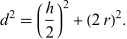 |
(1)
|
Consequently,
 |
(2)
|
so the volume is
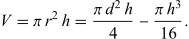 |
(3)
|
Its derivative is
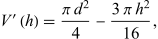 |
(4)
|
and the unique positive critical point therefore satisfies
 |
(5)
|
Since  tends to 0 at both degenerate endpoints
  and
and  , this point is the maximum.
At the maximizing proportions,
, this point is the maximum.
At the maximizing proportions,
 |  |  |
(6)
|
 |  |  |
(7)
|
and
 |
(8)
|
This explains why the Austrian cubic gauging rule  was accurate for barrels
of nearly optimal proportions. It was also insensitive to small departures from those
proportions because the first-order change in volume vanishes
at a maximum (Cardil 2012).
was accurate for barrels
of nearly optimal proportions. It was also insensitive to small departures from those
proportions because the first-order change in volume vanishes
at a maximum (Cardil 2012).
This calculation optimizes the proportions of a right circular cylinder; it does not find an optimal arbitrary curved barrel
profile. Kepler separately analyzed curved solids
of revolution as part of his broader study (Kepler 1615, 2018). A modern presentation
describes the optimization theory question
in terms of a wine seller's profit (Big Think 2026). Strictly, however, maximizing
 for fixed
  gives the greatest actual capacity for a fixed stick reading. Conversely, the literal
stick-length-to-volume ratio
gives the greatest actual capacity for a fixed stick reading. Conversely, the literal
stick-length-to-volume ratio  , as well as the cubic price proxy
  , has no nondegenerate maximum
in the unconstrained model of a cylinder, since either
ratio diverges as
, has no nondegenerate maximum
in the unconstrained model of a cylinder, since either
ratio diverges as  approaches an endpoint. A seller-profit
interpretation therefore requires additional practical constraints or a different
pricing model.
approaches an endpoint. A seller-profit
interpretation therefore requires additional practical constraints or a different
pricing model.
A horizontal cylindrical segment gives a different cylinder-volume problem, determining capacity from liquid depth rather than a diagonal gauge.
Kepler's barrel rule is a name for Simpson's rule, a numerical integration formula (Universität Stuttgart 2022, pp. 132-133). It should not be confused with Kepler's maximum-volume problem.

