

The Jacobi-Stirling numbers of the first kind  are the polynomial
sequence defined by
are the polynomial
sequence defined by
 |
(1)
|
for  ,
with
,
with  and
and  for positive integers
  and
and  . The companion Jacobi-Stirling numbers of the second kind
 satisfy
 |
(2)
|
with the same boundary conditions. At  ,
the two families specialize to the Legendre-Stirling
numbers of the first and second kinds, respectively; this simply sets
,
the two families specialize to the Legendre-Stirling
numbers of the first and second kinds, respectively; this simply sets  in the two recurrences.
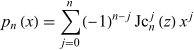
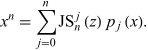
The two kinds are inverse polynomial connection coefficients. More explicitly, if
![p_n(x)=product_(r=0)^(n-1)[x-r(r+z)],](/images/equations/Jacobi-StirlingNumbers/NumberedEquation3.svg) |
(3)
|
then
 |
(4)
|
and
 |
(5)
|
Here a polynomial basis is a set of polynomials in which every polynomial in the relevant
vector space has a unique expression as a finite
linear combination of basis elements. Thus
the first-kind numbers convert the polynomial basis  to the monomial basis
  , while the second-kind numbers convert powers
  back to the basis
  .
.
The name "Jacobi" refers to the classical second-order Jacobi differential operator
![l_(alpha,beta)[y]=-(1-x^2)y^('')+[alpha-beta+(alpha+beta+2)x]y^',](/images/equations/Jacobi-StirlingNumbers/NumberedEquation6.svg) |
(6)
|
whose polynomial eigenfunctions are the Jacobi polynomials, with eigenvalues  . Taking
  explains the factors
  above: the Jacobi-Stirling numbers arise when powers
of this differential operator are expanded
in a natural differential-operator basis (Andrews et
al. 2013).
above: the Jacobi-Stirling numbers arise when powers
of this differential operator are expanded
in a natural differential-operator basis (Andrews et
al. 2013).
