

An isosceles set is a finite set of points in Euclidean space such that any three distinct points have at least two equal pairwise distances (Ionin 2009). Collinear triples are allowed. For example, the five vertices of a regular pentagon together with its center form an isosceles set (Erdős and Kelly 1947).
Let  be the largest number of points
in an isosceles set in
 . Its values for
 , 2, ... begin 3, 6, 8, 11, 17, 28, 30, 45, ... (OEIS
A175769). Yi (2026) proved
 |
where  ,
 is the largest number of points
in
 with at most two distinct nonzero
pairwise distances, and
 is the corresponding maximum when the points
lie on a hypersphere in
 . In particular,
 . In particular,
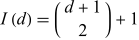 for
 and
 . For
 , a maximum set is
formed by the midpoints of the edges
of a regular simplex together with its geometric
centroid.

 -Points." Amer. Math. Monthly 54,
227-229, 1947.