

A Euclidean two-distance set is a finite set of points in  whose distances between
distinct points take exactly two values. It need not lie
on a hypersphere or have full affine dimension. Full
affine dimension means that the set is not contained in any affine hyperplane
of the ambient space (Larman et al. 1977). This differs from a two-distance
code, whose distances are measured by Hamming
distance. Every Euclidean two-distance set is an isosceles
set, since at least two of the three distances
in any triple agree.
Let  be the largest cardinality of a Euclidean two-distance
set in
 . Bu et al. (2026) proved
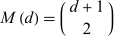 |
for  , and
 . For prescribed distance ratio
 , they proved the bound
 for every
 . With full affine dimension, equality forces
the Johnson configuration, represented by
 in its
 -dimensional affine hyperplane, where
 are the standard basis vectors
of
 . Full dimension is automatic for extremizers
when
 ;
dimension nine has an additional lower-dimensional exception.

 ." 29 Oct 2026.