


Isomorphic factorization colors the edges of a given graph  with
 colors so that the colored subgraphs
are isomorphic. The graph
 is then
 -splittable, with
 as the divisor, and the subgraph
as the factor.
When a complete graph is 2-split, a self-complementary graph results. Similarly, an  -regular class
1 graph can be
 -split into graphs consisting of disconnected edges, making
 the edge chromatic number.
The complete graph  can be 3-split into identical planar
graphs.
Some Ramsey numbers have been bounded via isomorphic factorizations. For instance, the complete graph  decomposes into three edge-disjoint copies of the Clebsch
graph, proving
 (Gardner 1989). That is, the complete graph on
16 points can be three-colored so that no triangle of a single color appears. (In
1955,
 was proven.)
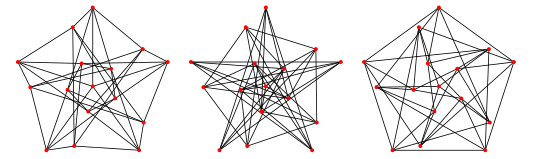
In addition,  can be 8-split with the Petersen graph as a factor,
or 5-split with a doubled cubical graph as a factor
(shown by Exoo in 2005).
The Hoffman-Singleton graph is 7-splittable into perfect matchings (Royle 2004). Mačaj
(2018) constructed a packing of six edge-disjoint Hoffman-Singleton
graphs in the complete graph  . He also showed that any decomposition into seven
copies must have a trivial color-preserving graph
automorphism group. The existence of such a decomposition is an unsolved
problem.

 ."
Conference slides. Pilsen, 2018.
 ."