


The inside-outside theorem states that if  and
and  are univariate polynomials
in a complex variable
are univariate polynomials
in a complex variable  whose polynomial degrees
satisfy
whose polynomial degrees
satisfy  ,
then
,
then
 |  |  |
(1)
|
 | 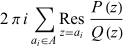 |  |
(2)
|
where  is a simple closed clockwise-oriented contour,
 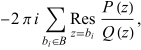 is the set of roots of
  inside of
  , and
, and  is the set of roots of
  outside of
  .
.
The first equality is the residue theorem with clockwise orientation. On the Riemann sphere, the
simple closed contour  splits the sphere into two regions. The degree hypothesis
ensures that the meromorphic one-form
splits the sphere into two regions. The degree hypothesis
ensures that the meromorphic one-form  has no pole at
  . Because the sum of all residues on the Riemann sphere
is zero, the sum of the inside residues is the negative of the sum of the outside
residues, giving the second equality.
. Because the sum of all residues on the Riemann sphere
is zero, the sum of the inside residues is the negative of the sum of the outside
residues, giving the second equality.
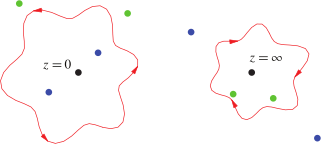
The above diagram shows two different points of view of the contour  and the poles of the meromorphic one-form
  on the Riemann sphere.
The usual point of view is centered at
on the Riemann sphere.
The usual point of view is centered at  , but the role of inside and outside is switched from the
point of view of
, but the role of inside and outside is switched from the
point of view of  . The poles inside are labeled blue and outside are green.
The theorem also follows from taking the contour integral at infinity, i.e., a circle of large radius  . The hypothesis on the degree says that this integral tends
to zero. Hence it must actually be zero, because at some point the circle contains
all of the poles of
. The hypothesis on the degree says that this integral tends
to zero. Hence it must actually be zero, because at some point the circle contains
all of the poles of  . This is a special case of the fact that on a compact Riemann surface, in this case the Riemann
sphere, the sum of the complex residues of
a meromorphic one-form is zero.
. This is a special case of the fact that on a compact Riemann surface, in this case the Riemann
sphere, the sum of the complex residues of
a meromorphic one-form is zero.
