

The initial form of a polynomial with respect to a real weight vector is the sum
of its polynomial terms of greatest weight. For
a nonzero polynomial  over a field
 , let
 and put
 , where
 ,
 is an exponent vector,
and the dot denotes the dot product. Then
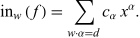 |
The initial form of the zero polynomial is defined to be zero. Several polynomial terms can have the same greatest weight, so an initial form need not be a single polynomial term (Fukuda et al. 2007).
For example, for  over
 , the weights
 ,
 , and
 give initial forms
 ,
 ,
and
 , respectively. Weight zero gives
 . With respect to a monomial
order, the initial form instead means the leading
term. The least-weight convention is obtained by replacing
 by
 .
