

The induced forest polynomial of a simple graph  with
with  vertices is
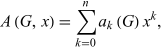 |
(1)
|
where  counts the
  -element
subsets
-element
subsets  of the vertex set for which
![G[S]](/images/equations/InducedForestPolynomial/Inline6.svg) is an induced forest. The empty
set contributes
is an induced forest. The empty
set contributes  . Barton et al. (2022) call this generating
function the acyclic polynomial, a name
also used for the different matching polynomial.
. Barton et al. (2022) call this generating
function the acyclic polynomial, a name
also used for the different matching polynomial.
The value  counts all induced forests, distinguished by their
vertex sets. Its polynomial
degree is the maximum number of vertices in an
induced forest, hence
counts all induced forests, distinguished by their
vertex sets. Its polynomial
degree is the maximum number of vertices in an
induced forest, hence  minus the feedback
vertex set number.
minus the feedback
vertex set number.
Every forest  on
on  vertices satisfies
 |
(2)
|
For a cycle graph  with
with  , only the full vertex set
is excluded, so
, only the full vertex set
is excluded, so
 |
(3)
|
For a complete graph  with
with  , only subsets of size at
most 2 contribute, giving
, only subsets of size at
most 2 contribute, giving
 |
(4)
|
The graph disjoint union of  and
and  satisfies
 |
(5)
|
