

An Ince polynomial is a trigonometric polynomial that solves the Ince equation with a nonnegative
integer degree parameter  , real
 , and a suitable value of the
spectral parameter
 . Its harmonics have frequencies at most
 and of the same parity as
 (Arscott 1967, NIST DLMF). The even
and odd families are denoted by
 and
 , respectively. Their
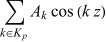
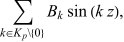
finite Fourier series have the forms
 |  |  |
(1)
|
 |  |  |
(2)
|
where  contains the nonnegative harmonic indices. The order
 ranges over
 for the even family and over its positive elements for the
odd family. Thus
 for either family.
To compute the coefficients, write the Ince equation as  , where
 . For either basis
function
 or
 ,
 |
(3)
|
The coefficient of the higher harmonic vanishes at  , so each finite Fourier space is invariant. The allowed
values of
 and the Fourier coefficients follow from the eigenvalues
and eigenvectors of the two finite matrices representing
 on these spaces (Arscott 1967, NIST
DLMF).
