

The impulse response function  of a linear
time-invariant system is its output when the input is the delta
function
of a linear
time-invariant system is its output when the input is the delta
function  and the initial state is zero. The zero-state condition excludes any output caused
by stored energy or a nonzero state before the input is applied, so the response
is due to the input alone. If the system's behavior is unchanged by a shift in time,
then the response to a general input
and the initial state is zero. The zero-state condition excludes any output caused
by stored energy or a nonzero state before the input is applied, so the response
is due to the input alone. If the system's behavior is unchanged by a shift in time,
then the response to a general input  is the convolution
 |
For a discrete-time linear time-invariant system, the corresponding convolution is
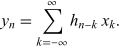 |
For a causal system,  for
for  and the lower limit can be replaced by 0 when the input
also vanishes before 0. The resulting causal convolution
from 0 to
and the lower limit can be replaced by 0 when the input
also vanishes before 0. The resulting causal convolution
from 0 to  is the Duhamel integral. The Fourier
transform of
is the Duhamel integral. The Fourier
transform of  is the frequency response,
while its Laplace transform is the transfer
function under the same zero-state condition.
is the frequency response,
while its Laplace transform is the transfer
function under the same zero-state condition.
