

The frequency response  of a linear
time-invariant system is defined by the response to an input
of a linear
time-invariant system is defined by the response to an input  : the corresponding output is
  . If
. If  is the impulse
response function, then
is the impulse
response function, then
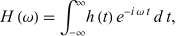 |
so the frequency response is the Fourier transform of the impulse response function. Its absolute value and phase describe the amplitude change and phase shift at each frequency.
