

The Duhamel integral computes the response  of a linear
time-invariant system that is a causal system,
assuming its initial state is zero and an input
of a linear
time-invariant system that is a causal system,
assuming its initial state is zero and an input  is applied at
  . In terms of the system's impulse
response function
. In terms of the system's impulse
response function  ,
the response is
,
the response is
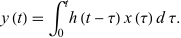 |
The zero-state condition means that the system has no stored response before the input is applied. The formula is the causal form of the convolution
of  and
and  .
.
For example, consider forced damped simple harmonic motion  with
with  and zero initial displacement and velocity. On writing
  ,
,  , and
, and  , its displacement is
![q(t)=1/(momega_d)int_0^tp(tau)e^(-zetaomega_n(t-tau))sin[omega_d(t-tau)]dtau.](/images/equations/DuhamelIntegral/NumberedEquation2.svg) |
