

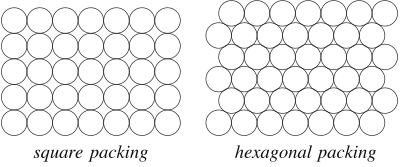
A hypersphere packing is an arrangement of nonoverlapping congruent hyperspheres in Euclidean space of any dimension. Two familiar periodic circle packings for identical circles in two dimensions are the square lattice and hexagonal lattice packings. In 1940, Fejes Tóth proved that the hexagonal lattice packing is the densest of all possible plane packings (Conway and Sloane 1993, pp. 8-9).
The analog of face-centered cubic packing is the densest lattice packing in four and five dimensions. In eight dimensions, the densest lattice packing is made up
of two copies of face-centered cubic. In six and seven dimensions, the densest lattice
packings are cross sections of the eight-dimensional
case. In 24 dimensions, the densest packing is the Leech
lattice (Cohn et al. 2017). For high dimensions ( -D), the densest known packings are nonlattice.
High-dimensional sphere packing also has a direct discrete interpretation in coding theory. In an error-correcting code, the codewords can be viewed as centers of nonoverlapping balls in Euclidean space, with the ball radius representing the errors or noise that can be corrected. Thus good packings correspond to signal sets that can be distinguished reliably, including in digital and wireless communication (Conway and Sloane 1993, Big Think 2026).
The densest lattice packings of hyperspheres in  dimensions are known rigorously for
  , 2, ..., 8, and have packing
densities
, 2, ..., 8, and have packing
densities  summarized in the following table, which also gives the corresponding Hermite
constants
summarized in the following table, which also gives the corresponding Hermite
constants  (Gruber and Lekkerkerker 1987, p. 518; Hilbert and Cohn-Vossen 1999, p. 47;
Finch) and relevant literature citations.
(Gruber and Lekkerkerker 1987, p. 518; Hilbert and Cohn-Vossen 1999, p. 47;
Finch) and relevant literature citations.
 |  |  | reference |
| 2 |  |  | Kepler 1611, 1619; Lagrange 1773 |
| 3 |  | 2 | Kepler 1611, 1619; Gauss 1840 |
| 4 |  | 4 | Korkin and Zolotarev 1877 |
| 5 |  | 8 | Korkin and Zolotarev 1877 |
| 6 |  |  | Blichfeldt 1934, Barnes 1957, Vetčinkin 1980 |
| 7 |  | 64 | Blichfeldt 1934, Watson 1966, Vetčinkin 1980 |
| 8 |  | 256 | Blichfeldt 1934, Watson 1966, Vetčinkin 1980 |
The packing densities  of the densest known non-lattice packings of
hyperspheres in dimensions up to 10 are given by Conway and Sloane (1995). Prior
to 2016, no proofs that any packing in dimensions greater than 3 was optimal were
known (cf. Sloane 1998). Viazovska (2017) proved that the
of the densest known non-lattice packings of
hyperspheres in dimensions up to 10 are given by Conway and Sloane (1995). Prior
to 2016, no proofs that any packing in dimensions greater than 3 was optimal were
known (cf. Sloane 1998). Viazovska (2017) proved that the  lattice provides the optimal packing in eight-dimensional
space, and Cohn et al. (2017) proved that the Leech
lattice is optimal in 24 dimensions.
lattice provides the optimal packing in eight-dimensional
space, and Cohn et al. (2017) proved that the Leech
lattice is optimal in 24 dimensions.
Let  denote the maximal packing density in
  , and let
  denote the optimal upper bound furnished by the Cohn-Elkies
linear programming method (Cohn and Elkies
2003). An AI-generated proof given by OpenAI (2026) established
denote the optimal upper bound furnished by the Cohn-Elkies
linear programming method (Cohn and Elkies
2003). An AI-generated proof given by OpenAI (2026) established
 |
(1)
|
Consequently, writing  gives
gives
 |
(2)
|
where  is little-o notation. This is the first
improvement since 1978 to the general sphere-packing exponent, improving the exponent
of Kabatyanskii and Levenshtein (1978). The matching lower bound for
is little-o notation. This is the first
improvement since 1978 to the general sphere-packing exponent, improving the exponent
of Kabatyanskii and Levenshtein (1978). The matching lower bound for  also shows that the Cohn-Elkies linear program cannot
yield a stronger exponential rate.
also shows that the Cohn-Elkies linear program cannot
yield a stronger exponential rate.
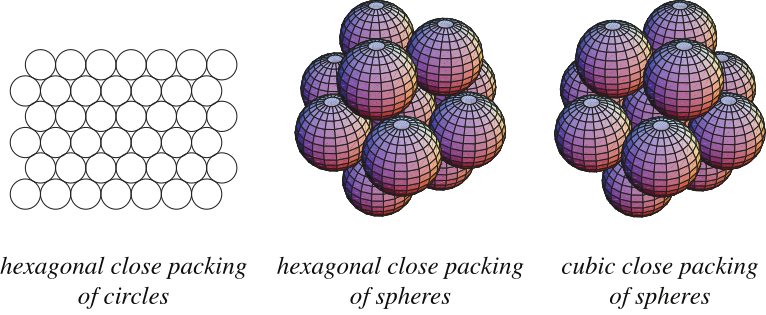
The largest number of unit circles which can touch a given unit circle is six. For spheres,
the maximum number is 12. Newton considered this question long before a proof was
published in 1874. The maximum number of hyperspheres that can touch another in  dimensions is the so-called kissing
number.
dimensions is the so-called kissing
number.
The following example illustrates the sometimes counterintuitive properties of hypersphere packings. Draw unit  -spheres in an
  -dimensional space centered at all
  coordinates. Now place an additional hypersphere
at the origin tangent to the other hyperspheres.
For
coordinates. Now place an additional hypersphere
at the origin tangent to the other hyperspheres.
For  and 3, the central hypersphere is contained inside
the hypercube with polytope
vertices at the centers of the other spheres. For
and 3, the central hypersphere is contained inside
the hypercube with polytope
vertices at the centers of the other spheres. For  , the central hypersphere
just touches the hypercube of centers, and for
, the central hypersphere
just touches the hypercube of centers, and for  , the central hypersphere
is partially outside the hypercube.
, the central hypersphere
is partially outside the hypercube.
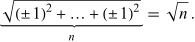
This fact can be demonstrated by finding the distance from the origin to the center of one of the  hyperspheres, which is given by
 |
(3)
|
The radius of the central sphere is therefore  . Now, the distance from the origin to the center of
a facet bounding the hypercube
is always 1 (one hypersphere radius), so the center hypersphere
is tangent to the hypercube when
. Now, the distance from the origin to the center of
a facet bounding the hypercube
is always 1 (one hypersphere radius), so the center hypersphere
is tangent to the hypercube when  , or
, or  , and partially outside it for
  .
.
Let  be the supremum of the packing densities of lattice
hypersphere packings in
be the supremum of the packing densities of lattice
hypersphere packings in  . Gargava et al. (2026) established
 |
(4)
|
for an absolute constant  and every sufficiently large integer
  . Their cyclotomic gluing construction
extends the logarithmic gain to every sufficiently large dimension,
rather than only a sparse sequence of dimensions. Gargava
et al. (2026) report that ChatGPT-assisted exploration produced a weaker result
that was subsequently developed and checked by the authors.
. Their cyclotomic gluing construction
extends the logarithmic gain to every sufficiently large dimension,
rather than only a sparse sequence of dimensions. Gargava
et al. (2026) report that ChatGPT-assisted exploration produced a weaker result
that was subsequently developed and checked by the authors.

 -Spheres are Nonplanar." Disc. Comput. Geom. 24,
539-549, 2000.Sloane, N. J. A. "Kepler's Conjecture Confirmed."
Nature 395, 435-436, 1998.Vetčinkin, N. M. "Uniqueness
of Classes of Positive Quadratic Forms on Which Values of the Hermite Constants Are
Attained for
-Spheres are Nonplanar." Disc. Comput. Geom. 24,
539-549, 2000.Sloane, N. J. A. "Kepler's Conjecture Confirmed."
Nature 395, 435-436, 1998.Vetčinkin, N. M. "Uniqueness
of Classes of Positive Quadratic Forms on Which Values of the Hermite Constants Are
Attained for  ."
Trudy Mat. Inst. Steklov 148, 65-76, 1978. English translation in Proc.
Steklov Inst. Math. 148, 63-74, 1980.Viazovska, M. S.
"The Sphere Packing Problem in Dimension 8." Ann. Math. 185,
991-1015, 2017.
."
Trudy Mat. Inst. Steklov 148, 65-76, 1978. English translation in Proc.
Steklov Inst. Math. 148, 63-74, 1980.Viazovska, M. S.
"The Sphere Packing Problem in Dimension 8." Ann. Math. 185,
991-1015, 2017.  (
( ) Variables. Verification of Blichfeldt's Calculation."
Proc. Cambridge Philos. Soc. 62, 719, 1966.
) Variables. Verification of Blichfeldt's Calculation."
Proc. Cambridge Philos. Soc. 62, 719, 1966.