The kissing number
is the largest number of congruent nonoverlapping hyperspheres
in -dimensional Euclidean
space that can touch a congruent central hypersphere.
It is also called the Newton number, contact number, coordination number, or ligancy.
Equivalently, the points of tangency form a spherical
code on
with pairwise angles of at least . In the standard notation for spherical
codes,
The three-dimensional problem was discussed by Newton and David Gregory in 1694. Newton asserted that 12 spheres could touch the central
sphere, while Gregory considered whether 13 might be possible.
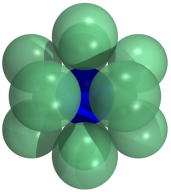
A configuration of 12 is obtained by placing the points of tangency at the polyhedron
vertices of a regular icosahedron, but
enough space remains to make the impossibility of a 13th sphere
far from visually obvious. The first generally accepted proof that was published by Schütte and van der Waerden (1953),
followed by a shorter proof by Leech (1956).
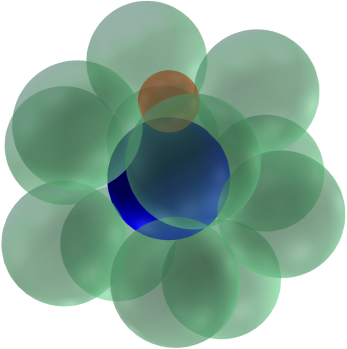
The asymmetric kissing configuration shown above creates a larger hole containing a smaller sphere of radius. This
smaller sphere touches the central sphere
and four surrounding spheres. Since , it does not provide a 13th unit
sphere.
The exact values currently known are , , , , , and . Musin (2008) proved using a modification of Delsarte's method. The values
for
and 24 are realized by the root lattice and the Leech lattice, respectively (Odlyzko and Sloane 1979).
For every other ,
the exact value remains unknown.
The following table gives the best general lower bounds and upper
bounds
known for
as of August 2026; equal entries are exact (Cohn). A continuously maintained table,
including larger values of and references for each bound, is provided by Cohn.
1
2
2
13
2
6
6
14
3
12
12
15
4
24
24
16
5
40
44
17
6
72
77
18
7
126
134
19
8
240
240
20
9
306
363
21
10
510
553
22
11
593
868
23
12
840
24
As ,
an AI-generated proof given by OpenAI (2026) established
where
is little-o notation. This improves the
optimized classical exponent of Kabatyanskii and Levenshtein (1978).
Ho (2026) constructed 11948 kissing spheres in dimension 19 using a 1280-word subcode of a punctured binary Golay code. Kolosov (2026) proved that the 1280-word added-vector
code in Ho's 19-dimensional construction is optimal among subsets of the specified
4096-word binary code with minimum Hamming
distance at least 5. The upper bound partitions the code into 256 classes whose
forbidden-distance graphs are Clebsch
graphs, each with independence number
5. This establishes optimality within that code and does not give an upper bound
of 11948 for the unrestricted 19-dimensional kissing number. The proof
was co-developed with AI and its exact certificate was replayed by VibeMathed (2026),
but independent specialist review had not been reported as of Sep. 7, 2026.
Bender, C. "Bestimmung der grössten Anzahl gleich Kugeln, welche sich auf eine Kugel von demselben Radius, wie die übrigen, auflegen
lassen." Archiv Math. Physik (Grunert)56, 302-306, 1874.Cohn,
H. "Kissing Numbers." https://cohn.mit.edu/kissing-numbers/.Conway,
J. H. and Sloane, N. J. A. "The Kissing Number Problem"
and "Bounds on Kissing Numbers." §1.2 and Ch. 13 in Sphere
Packings, Lattices, and Groups, 2nd ed. New York: Springer-Verlag, pp. 21-24
and 337-339, 1993.Edel, Y.; Rains, E. M.; and Sloane, N. J. A.
"On Kissing Numbers in Dimensions 32 to 128." Elec. J. Combin.5,
R22, 1998. https://doi.org/10.37236/1360.Günther,
S. "Ein stereometrisches Problem." Archiv Math. Physik57,
209-215, 1875.Ho, B. S. "A New Lower Bound for the Kissing
Number in 19 Dimensions." 11 Mar 2026. https://arxiv.org/abs/2603.10425.Hoppe,
R. "Bemerkung der Redaction." Archiv Math. Physik. (Grunert)56,
307-312, 1874.Kabatyanskii, G. A. and Levenshtein, V. I. "Bounds
for Packing on a Sphere and in Space." Problems Inform. Transm.14,
1-17, 1978.Kolosov, A. M. "Optimality of the Added-Vector
Code in the 19-Dimensional Kissing Construction." 2026. https://github.com/cheptil/kissing-number-19-dimensions.Kuperberg,
G. "Average Kissing Numbers for Sphere Packings." Preprint.Kuperberg,
G. and Schramm, O. "Average Kissing Numbers for Non-Congruent Sphere Packings."
Math. Res. Let.1, 339-344, 1994.Leech, J. "The Problem
of Thirteen Spheres." Math. Gaz.40, 22-23, 1956.Musin,
O. R. "The Kissing Number in Four Dimensions." Ann. Math.168,
1-32, 2008. https://doi.org/10.4007/annals.2008.168.1.Odlyzko,
A. M. and Sloane, N. J. A. "New Bounds on the Number of Unit
Spheres That Can Touch a Unit Sphere in Dimensions." J. Combin. Th. A26, 210-214,
1979.OpenAI. "Improved Bounds for Binary and Spherical Codes."
Ch. 2 in Ten Advances in Mathematics and Theoretical Computer Science.
Aug. 1, 2026. https://cdn.openai.com/pdf/ten-proofs-oai.pdf.Pfender,
F. and Ziegler, G. "Kissing Numbers, Sphere Packings, and Some Unexpected Proofs."
Not. Amer. Math. Soc.51, 873-883, 2004.Schütte,
K. and van der Waerden, B. L. "Das Problem der dreizehn Kugeln." Math.
Ann.125, 325-334, 1953.Sloane, N. J. A. Sequence
A001116/M1585 in "The On-Line Encyclopedia
of Integer Sequences."Stewart, I. The
Problems of Mathematics, 2nd ed. Oxford, England: Oxford University Press,
pp. 82-84, 1987.VibeMathed. "Optimality of the Added-Vector
Code in the 19-Dimensional Kissing Construction." Sep. 6, 2026. https://vibemathed.com/problem/optimality-of-the-added-vector-code-in-the-19-dimensional-kissing-construction.Wells,
D. The
Penguin Dictionary of Curious and Interesting Numbers. Middlesex, England:
Penguin Books, p. 84, 1986.Zinov'ev, V. A. and Ericson, T.
"New Lower Bounds for Contact Numbers in Small Dimensions." Prob. Inform.
Transm.35, 287-294, 1999.Zong, C. and Talbot, J. Sphere
Packings. New York: Springer-Verlag, 1999.


 is the largest number of congruent nonoverlapping hyperspheres
in
is the largest number of congruent nonoverlapping hyperspheres
in  -dimensional Euclidean
space that can touch a congruent central hypersphere.
It is also called the Newton number, contact number, coordination number, or ligancy.
Equivalently, the points of tangency form a spherical
code on
-dimensional Euclidean
space that can touch a congruent central hypersphere.
It is also called the Newton number, contact number, coordination number, or ligancy.
Equivalently, the points of tangency form a spherical
code on  with pairwise angles of at least
  . In the standard notation for spherical
codes,
. In the standard notation for spherical
codes,

 was published by Schütte and van der Waerden (1953),
followed by a shorter proof by Leech (1956).
was published by Schütte and van der Waerden (1953),
followed by a shorter proof by Leech (1956).
 . This
smaller sphere touches the central sphere
and four surrounding spheres. Since
. This
smaller sphere touches the central sphere
and four surrounding spheres. Since  , it does not provide a 13th unit
sphere.
, it does not provide a 13th unit
sphere.
 ,
,  ,
,  ,
,  ,
,  , and
, and  . Musin (2008) proved
  using a modification of Delsarte's method. The values
for
using a modification of Delsarte's method. The values
for  and 24 are realized by the
  root lattice and the Leech lattice, respectively (Odlyzko and Sloane 1979).
For every other
root lattice and the Leech lattice, respectively (Odlyzko and Sloane 1979).
For every other  ,
the exact value remains unknown.
,
the exact value remains unknown.
 and upper
bounds
and upper
bounds  known for
  as of August 2026; equal entries are exact (Cohn). A continuously maintained table,
including larger values of
as of August 2026; equal entries are exact (Cohn). A continuously maintained table,
including larger values of  and references for each bound, is provided by Cohn.


 ,
an AI-generated proof given by OpenAI (2026) established
,
an AI-generated proof given by OpenAI (2026) established

 is little-o notation. This improves the
optimized classical exponent
is little-o notation. This improves the
optimized classical exponent  of Kabatyanskii and Levenshtein (1978).

 Dimensions." J. Combin. Th. A 26, 210-214,
1979.OpenAI. "Improved Bounds for Binary and Spherical Codes."
Ch. 2 in Ten Advances in Mathematics and Theoretical Computer Science.
Aug. 1, 2026.
Dimensions." J. Combin. Th. A 26, 210-214,
1979.OpenAI. "Improved Bounds for Binary and Spherical Codes."
Ch. 2 in Ten Advances in Mathematics and Theoretical Computer Science.
Aug. 1, 2026.